Introduction
Packaging is no longer just a protective layer around a product. In crowded retail and export markets, the bag itself can influence brand recognition, product positioning, and buyer confidence. That is why BOPP Bag Printing is becoming increasingly important for businesses that want packaging to combine durability with strong visual impact.
BOPP laminated bags use a biaxially oriented polypropylene film over woven polypropylene fabric, creating a surface that supports sharp graphics while maintaining the strength required for transportation and handling. Modern manufacturers can also combine different finishes, colours, artwork styles, and construction options to create packaging suited to specific products and markets.
For companies planning new packaging in 2026, understanding current BOPP bag printing trends can help avoid costly design mistakes and create a more competitive finished product. You can also explore this custom printed PP woven bags printing guide for a broader look at printing choices and design considerations.
Why BOPP Bag Printing Matters in 2026
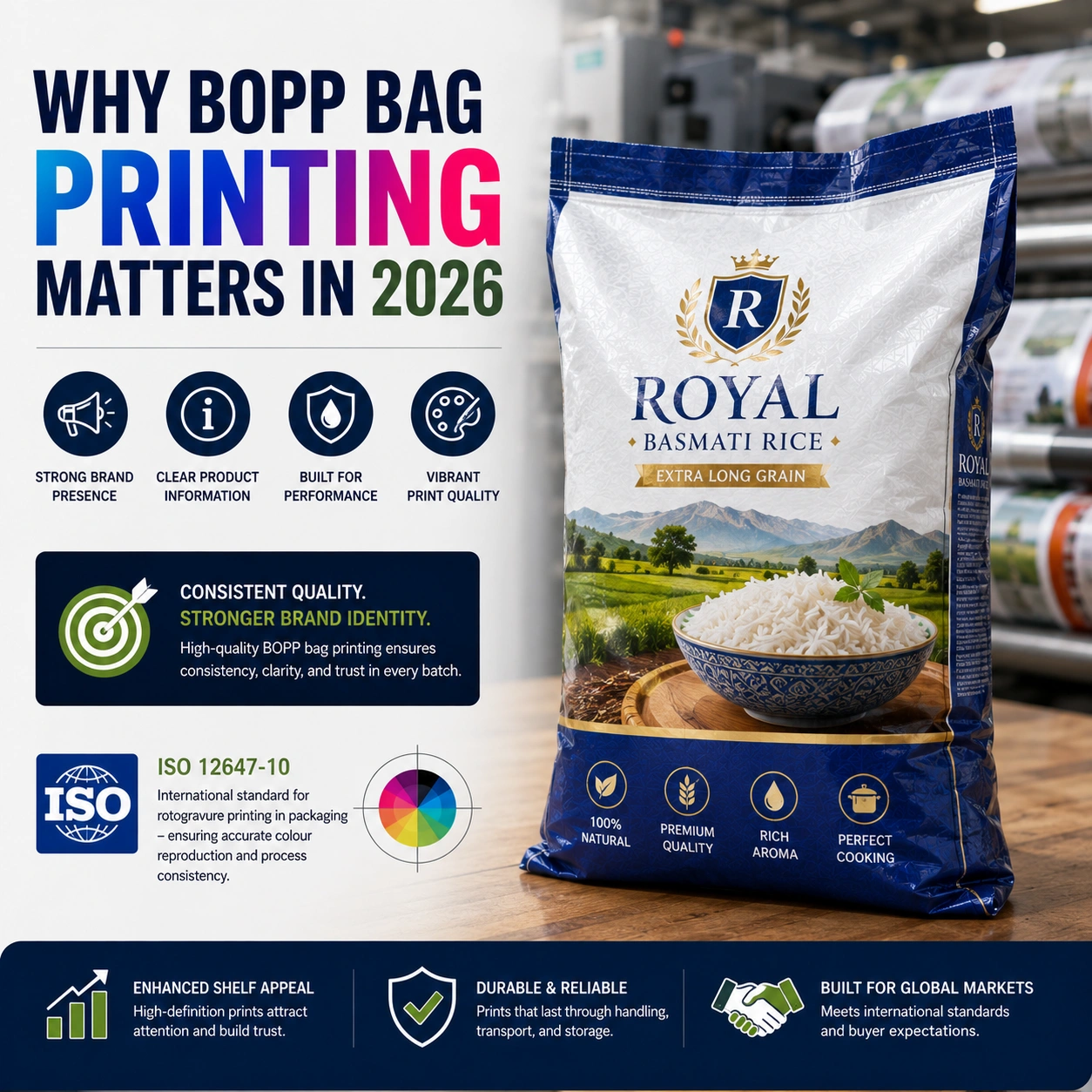
The biggest change in packaging is the growing connection between functionality and branding. A rice, flour, seed, pet food, or fertilizer bag may need to survive stacking, transportation, moisture exposure, and repeated handling, but it must also communicate product information clearly.
This makes BOPP Bag Printing particularly valuable. The smooth film surface provides an attractive base for detailed graphics, strong colour reproduction, logos, product photography, and carefully positioned text. For consumer-facing products, the packaging can act almost like a miniature billboard on a retail shelf.
At the same time, international buyers increasingly expect consistency between batches. A design that looks excellent on the first shipment but changes noticeably on the next can weaken brand identity. High-quality production therefore requires more than attractive artwork; it requires controlled printing, accurate colour reproduction, suitable inks, and reliable manufacturing processes.
ISO is also developing ISO 12647-10 specifically for packaging rotogravure printing, with attention to colourimetric printing aims, colour characterization data, and process tolerances. (ISO)
1. High-Definition BOPP Bag Printing Is Becoming the Standard
One of the most important BOPP Bag Printing trends in 2026 is the move toward increasingly detailed graphics. Brands are using photographic imagery, gradients, fine illustrations, subtle shadows, and more sophisticated typography instead of relying only on simple logos and solid colours.
The smooth BOPP film makes this possible because it provides a suitable print surface for sharp and vibrant graphics. When artwork preparation, cylinder engraving, ink application, and colour control work together, the final bag can achieve a premium appearance that is difficult to reproduce on conventional rough woven surfaces.
For example, a pet food manufacturer might use a realistic product photograph with detailed animal imagery, while a rice brand may use agricultural landscapes, grain photography, and premium metallic-style accents. The objective is not simply to add more graphics but to make every visual element support the product's positioning.
2. Rotogravure Printing Technology Continues to Drive Premium Results
Rotogravure remains an important technology for high-quality packaging because it can deliver consistent, detailed reproduction at production scale. The process uses engraved cylinders containing microscopic cells that hold controlled quantities of ink before transferring it to the substrate. The Global Rotogravure Association describes modern gravure as a computer-controlled process known for print quality, consistency, versatility, and speed.
For BOPP packaging printing, this level of control is especially useful when a design contains multiple colours, photographic images, gradients, or detailed branding. Correct cylinder preparation and registration are essential because even small alignment differences can become noticeable when several colours overlap.
Modern BOPP bag printing technology therefore focuses not only on printing speed but also on repeatability. For large orders, maintaining similar colour, registration, sharpness, and coverage throughout production is often more valuable than achieving a visually impressive result on a single sample.
3. Matte and Gloss Finishes Create Different Brand Personalities
Finish selection has become a major part of BOPP bag design. Gloss surfaces create a bright, energetic appearance and can make colours appear more vivid, while matte finishes provide a softer and more sophisticated visual character.
A premium food brand may prefer a controlled matte appearance to communicate quality and refinement. In contrast, a mass-market agricultural product might benefit from a high-gloss finish that creates strong shelf visibility. Neither option is universally better; the right choice depends on the product, target customer, distribution environment, and desired brand identity.
Some packaging designs also use contrasting visual effects, such as a predominantly matte appearance combined with selected glossy areas. This approach can direct attention toward a logo, product image, or key message without making the entire package visually overwhelming.
4. Minimalist BOPP Bag Designs Are Gaining Attention
More graphics do not automatically mean better packaging. One noticeable trend in BOPP Bag Printing is the use of cleaner layouts with fewer competing elements.
Minimalist designs typically use controlled colour palettes, generous negative space, strong typography, and a clearly defined brand hierarchy. This can make essential information easier to recognise from a distance, particularly when several competing products appear together.
For example, instead of filling an entire bag with multiple illustrations and promotional messages, a brand might use a large central logo, one strong product image, two or three supporting colours, and concise information. This approach can make the package look more modern while improving visual communication.
The important point is that minimalism should not be confused with simplicity in manufacturing. A clean design may still require highly accurate colour reproduction, precise registration, detailed artwork preparation, and carefully controlled printing.
5. Custom BOPP Bags Are Moving Toward More Personalised Designs
Businesses increasingly want packaging that reflects their individual brand rather than a generic catalogue design. This is driving demand for custom BOPP bags with tailored dimensions, artwork, colours, finishes, and construction features.
Customisation is particularly valuable for businesses selling products through competitive retail channels. Packaging can differentiate product variants while maintaining a consistent master brand. For example, different colours can represent different rice varieties, pet food flavours, fertilizer grades, or agricultural seed categories.
However, successful customisation starts before printing. Artwork should account for bag dimensions, seam areas, gussets, handles, stitching, filling requirements, and other structural features. A beautiful graphic can lose its impact if important text falls into a fold or becomes difficult to read after bag conversion.
6. Premium Printed BOPP Bags Are Combining Function and Branding
The modern premium package needs to perform two jobs simultaneously: protect the contents and communicate value. This is why premium printed BOPP bags are increasingly designed as complete packaging systems rather than simply printed sacks.
The woven PP structure provides mechanical strength, while the BOPP layer can contribute moisture resistance, surface protection, and a high-quality printable surface. This combination makes BOPP packaging useful across food, agriculture, chemicals, pet food, construction, and other applications.
For exporters, the visual quality of packaging can also influence how a product is perceived when it reaches a new market. Consistent branding, readable information, durable construction, and professional finishing can collectively create a stronger impression of product quality.
7. Colour Accuracy and Print Consistency Are Becoming More Important
A major BOPP Bag Printing challenge is maintaining colour consistency between the approved artwork, proof, and final production. Brand owners often have specific colours that must remain visually consistent across packaging batches.
Colour management becomes particularly important when a design contains corporate colours, photographs, gradients, or multiple spot colours. ISO's packaging-printing guidance highlights the importance of colour-managed workflows and defined aims and tolerances for colour reproduction.
Before approving a bulk order, buyers should therefore review a production-representative sample rather than judging the artwork only on a computer screen. Screen colours and printed colours are not identical, and the final appearance can also depend on the film, ink system, finish, and viewing conditions.
8. Design Trends Are Moving Beyond Traditional Four-Colour Thinking
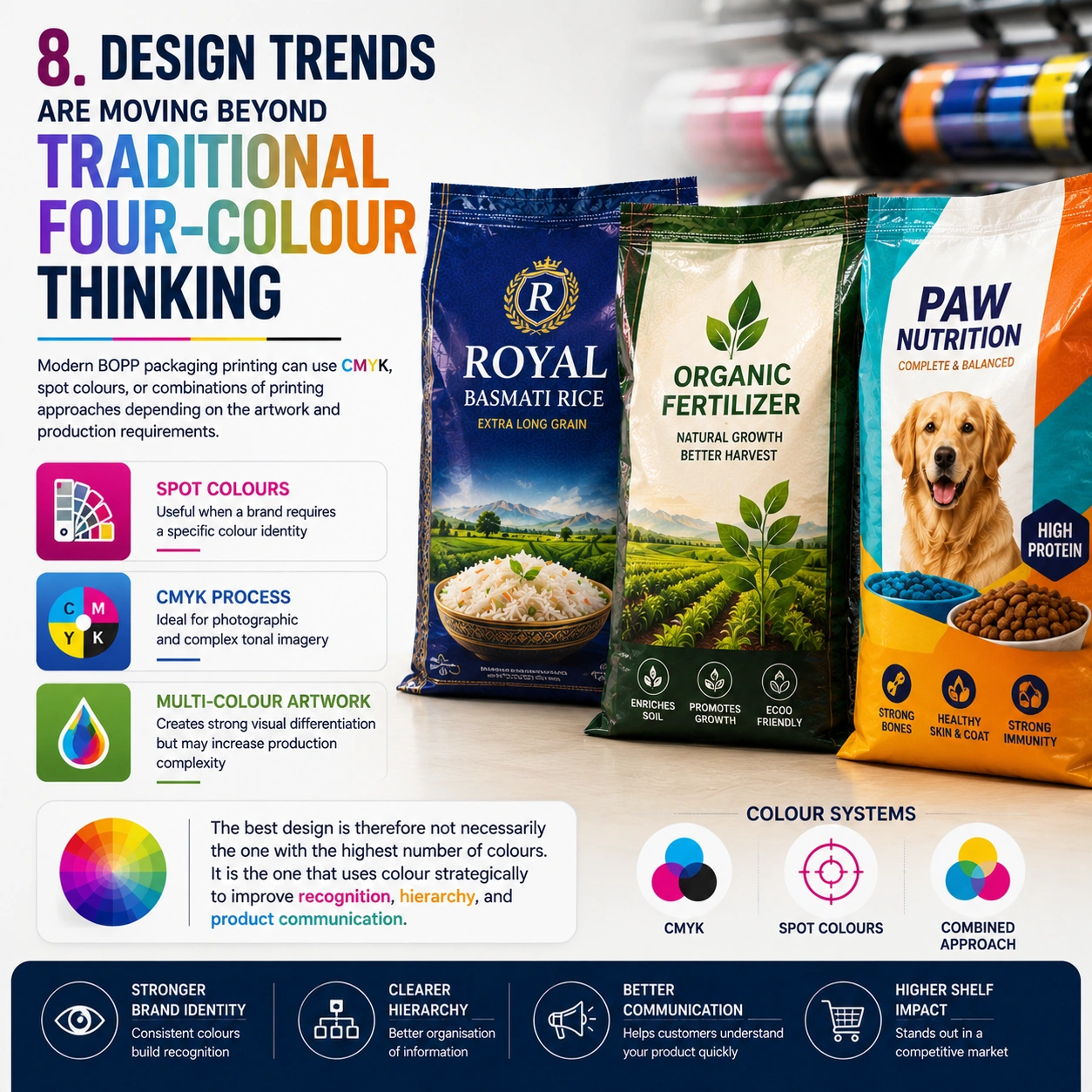
Modern BOPP packaging printing can use CMYK, spot colours, or combinations of printing approaches depending on the artwork and production requirements. Designers are consequently experimenting with more distinctive colour systems rather than treating every package as a standard four-colour layout.
Spot colours can be useful when a brand requires a specific colour identity, while CMYK processes are particularly useful for photographic and complex tonal imagery. Multi-colour artwork can create strong visual differentiation, but additional colours can also increase production complexity and should have a clear purpose.
The best design is therefore not necessarily the one with the highest number of colours. It is the one that uses colour strategically to improve recognition, hierarchy, and product communication.
BOPP Bag Printing Technology: Traditional vs Modern Priorities
| Printing consideration | Conventional approach | 2026-focused approach |
|---|---|---|
| Artwork | Basic graphics | Detailed, brand-led visual systems |
| Colour | General colour matching | Controlled colour management |
| Images | Simple illustrations | High-resolution photography and gradients |
| Finish | Mainly standard gloss | Gloss, matte and combination effects |
| Branding | Logo-focused | Complete visual identity |
| Quality control | Finished-product inspection | Process control throughout production |
| Customisation | Limited variations | Product-specific designs and structures |
| Consistency | Batch-to-batch variation may occur | Strong focus on repeatability |
The shift is clear: BOPP bag printing is increasingly treated as a controlled packaging-production process rather than an isolated printing step.
9. Sustainability Is Influencing Printing and Design Decisions
Sustainability is also becoming part of packaging conversations, but it should be approached realistically. A printed bag cannot be considered sustainable simply because its artwork uses earthy colours or displays an environmental message.
Businesses are increasingly examining material structures, production efficiency, packaging weight, durability, and responsible use of resources alongside visual design. A durable bag that reduces product loss or survives demanding transportation may provide functional advantages that should be considered as part of the overall packaging strategy.
Printing decisions should therefore support the broader packaging specification. Buyers should discuss the intended application, regulatory requirements, product compatibility, and target market with the manufacturer rather than choosing a printing approach based purely on appearance.
10. What Makes High Quality BOPP Printing?
High quality BOPP printing depends on the interaction between artwork, film, inks, machinery, printing parameters, and quality control. A strong design cannot compensate for poor registration, inconsistent ink application, unsuitable artwork preparation, or inadequate inspection.
Before production, buyers should check whether the manufacturer can provide an appropriate sample and explain how colour consistency will be controlled. It is also useful to confirm printing colours, finish, dimensions, bag construction, artwork approval procedures, and inspection expectations in writing.
A reliable supplier should be able to discuss these factors clearly rather than focusing only on the final price. For large international orders, communication at the specification stage can prevent expensive corrections after production begins.
How to Choose the Right BOPP Bag Design for Your Product
The best BOPP bag design starts with the product rather than the printing machine. Consider where the bag will be sold, how it will be transported, how customers will view it, and what information they need to understand immediately.
A retail food product may need strong shelf appeal and photographic graphics. An agricultural product may need highly visible product identification and technical information. An industrial product may prioritise durability, handling instructions, and clear identification over elaborate graphics.
The physical structure also matters. Bag size, GSM, fabric construction, lamination, stitching, handles, ventilation, and opening style should be considered alongside the artwork. Oberon Polypack, for example, describes BOPP bags with different sizes, GSM options, finishes, printing styles, and customisation possibilities.
Practical Checklist Before Ordering Printed BOPP Bags
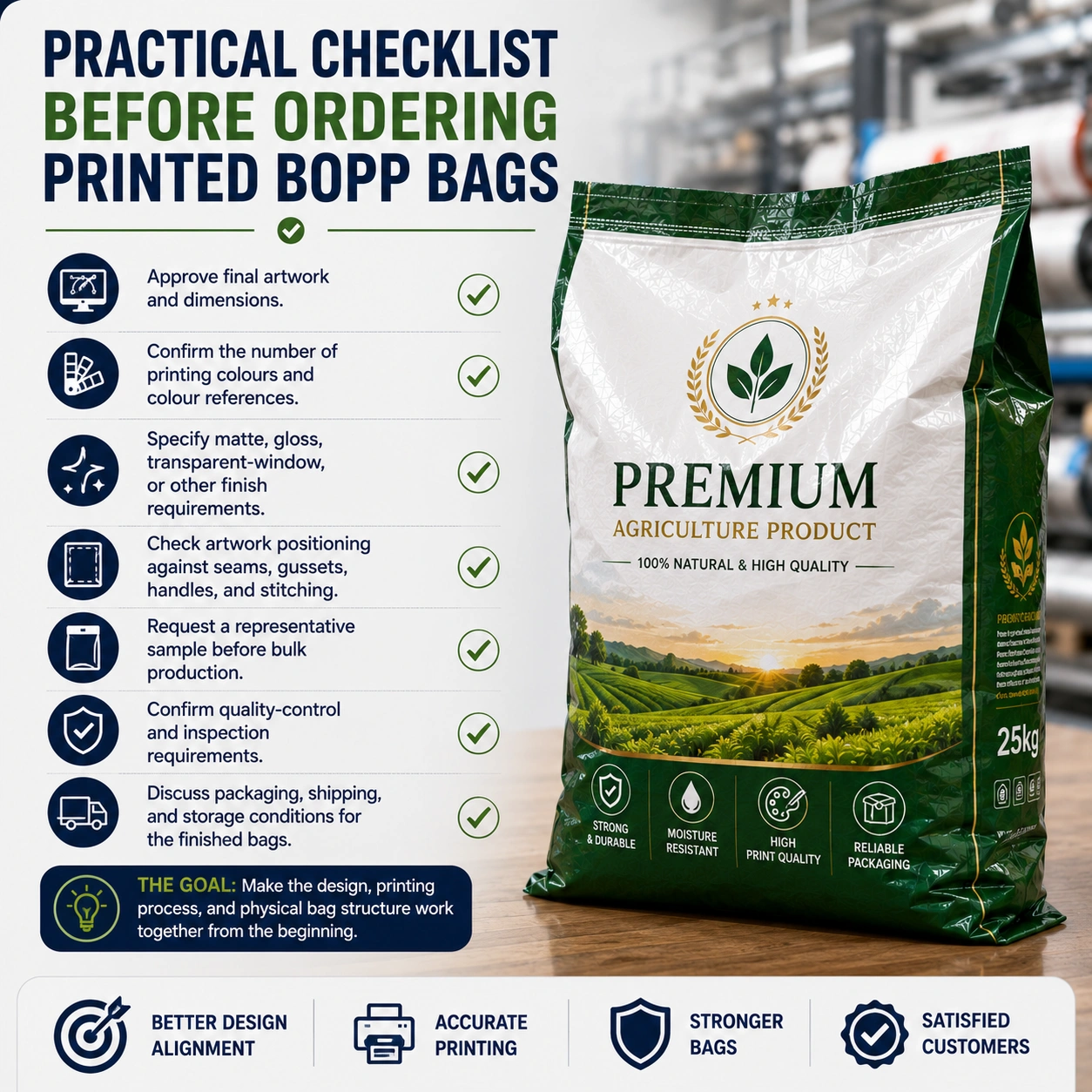
For most buyers, a short technical review before production can eliminate many avoidable problems:
- Approve final artwork and dimensions.
- Confirm the number of printing colours and colour references.
- Specify matte, gloss, transparent-window, or other finish requirements.
- Check artwork positioning against seams, gussets, handles, and stitching.
- Request a representative sample before bulk production.
- Confirm quality-control and inspection requirements.
- Discuss packaging, shipping, and storage conditions for the finished bags.
The goal is to make the design, printing process, and physical bag structure work together from the beginning.
The Future of Customized BOPP Woven Bags
The next stage of BOPP packaging will likely be defined by greater customisation, stronger colour control, better artwork reproduction, and closer integration between packaging design and manufacturing. Buyers are no longer looking only for a bag that can carry a product; they want packaging that contributes to brand value while performing reliably through the supply chain.
That makes the manufacturer's technical capability increasingly important. A supplier must understand not only printing but also extrusion, weaving, lamination, bag conversion, quality inspection, and export requirements. A coordinated production process can reduce inconsistencies between the printed surface and the physical structure of the finished bag.
Conclusion
BOPP Bag Printing in 2026 is moving toward higher-definition graphics, more sophisticated finishes, stronger colour control, personalised packaging, and increasingly advanced printing technology. Rotogravure remains an important solution for detailed packaging graphics, while matte and gloss finishes, minimalist layouts, photographic artwork, and carefully managed brand colours are giving businesses more ways to differentiate their products. The most successful packaging combines visual appeal with structural performance, consistency, and practical suitability for its intended market.
If you are planning custom BOPP packaging for food, agriculture, pet food, fertilizer, chemicals, construction, or other products, choosing the right manufacturing partner is just as important as choosing the artwork. Oberon Polypack provides customised BOPP bags with options for sizes, GSM, finishes, printing styles, and branding requirements.
FAQs
1. What is BOPP Bag Printing?
BOPP Bag Printing is the process of applying graphics, branding, product information, and other visual elements to BOPP-laminated woven bags. The BOPP film provides a smooth printable surface that can support detailed, vibrant graphics while the woven polypropylene structure provides strength and durability.
2. Which printing technology is commonly used for premium BOPP bags?
Rotogravure is widely used for premium flexible and packaging printing because it can provide detailed image reproduction, consistent colour application, and high production efficiency. The technology uses engraved cylinders and controlled ink transfer to reproduce artwork accurately across production runs.
3. Are matte BOPP bags better than glossy BOPP bags?
Neither finish is automatically better. Gloss finishes can provide stronger visual brightness and vibrant colour appearance, while matte finishes can create a more refined and understated look. The right choice depends on brand positioning, product category, market expectations, and the desired visual effect.
4. How can businesses maintain consistent printing quality across large orders?
Businesses should approve production-representative samples, define colour requirements clearly, confirm artwork specifications, and work with manufacturers that use controlled printing and quality-inspection processes. Consistent colour management and clearly defined production tolerances are particularly important for established brands.
5. What should buyers check before ordering customized BOPP woven bags?
Buyers should review bag dimensions, fabric and GSM requirements, lamination, printing colours, artwork positioning, finish, stitching, handles or other construction features, sample approval, quality standards, and delivery requirements. Reviewing these details before bulk production can significantly reduce the risk of costly errors.