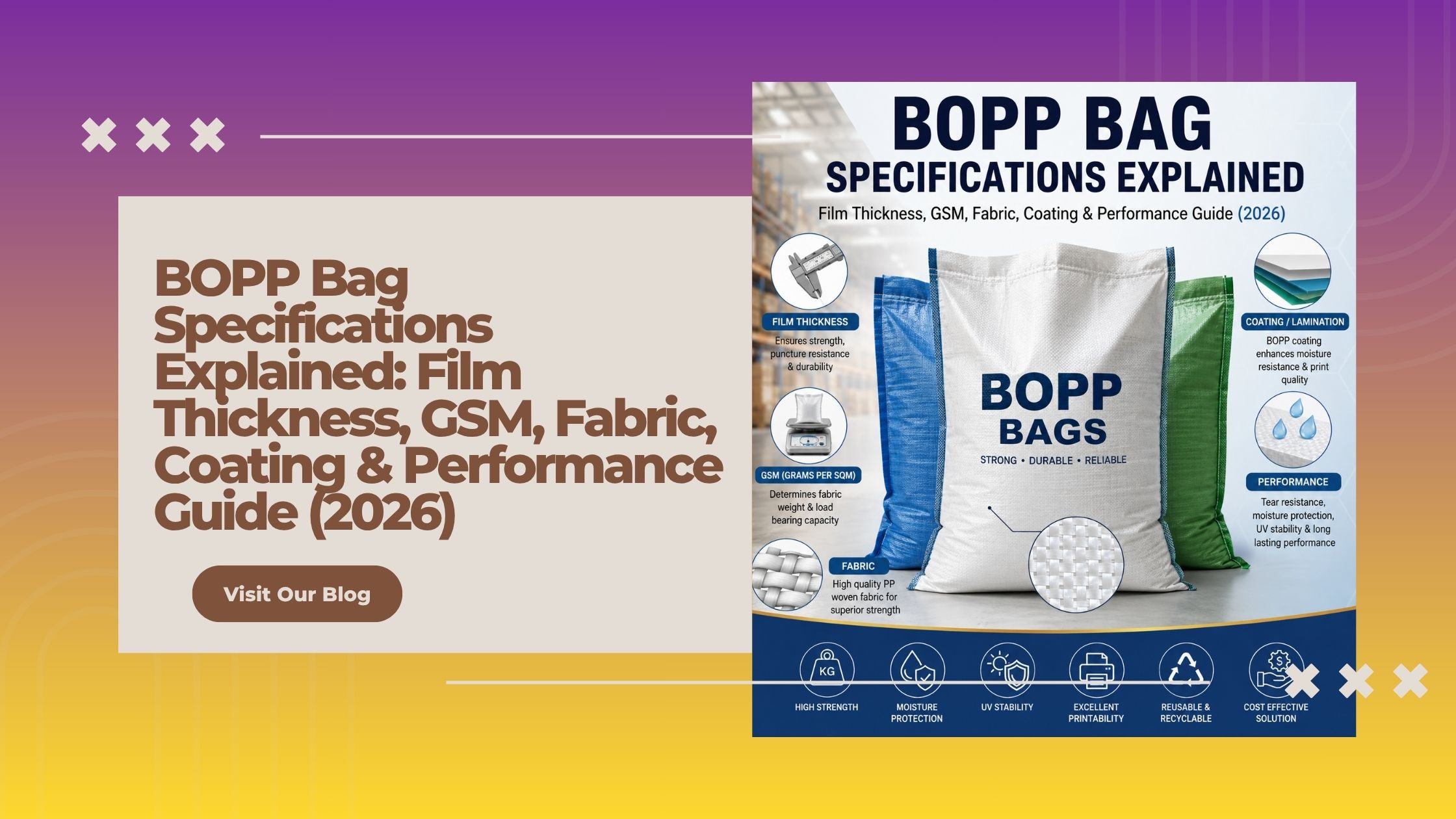
Choosing the right packaging bag isn't simply about selecting the correct size. Whether you're packing animal feed, fertilizer, cement, food products, seeds, or industrial materials, the technical specifications of the bag determine how well it performs during filling, transportation, storage, and export. A bag that looks identical on the outside may vary significantly in strength, durability, print quality, and load-bearing capacity because of differences in its construction. Understanding BOPP Bag specifications helps businesses make informed purchasing decisions while reducing product damage and packaging costs.
Today, BOPP laminated bags have become one of the most widely used flexible packaging solutions across global industries. Their excellent printability, moisture resistance, high tensile strength, and attractive appearance make them suitable for both retail and industrial packaging. However, selecting the correct film thickness, GSM, woven fabric, coating, and lamination requires a clear understanding of how each specification affects overall bag performance.
In this guide, you'll learn everything you need to know about BOPP bag specifications, including fabric construction, film thickness, GSM, coating options, weight capacity, and manufacturing standards. Whether you're a buyer, exporter, packaging engineer, or distributor, this guide will help you choose packaging that matches your application.
What Is a BOPP Bag?
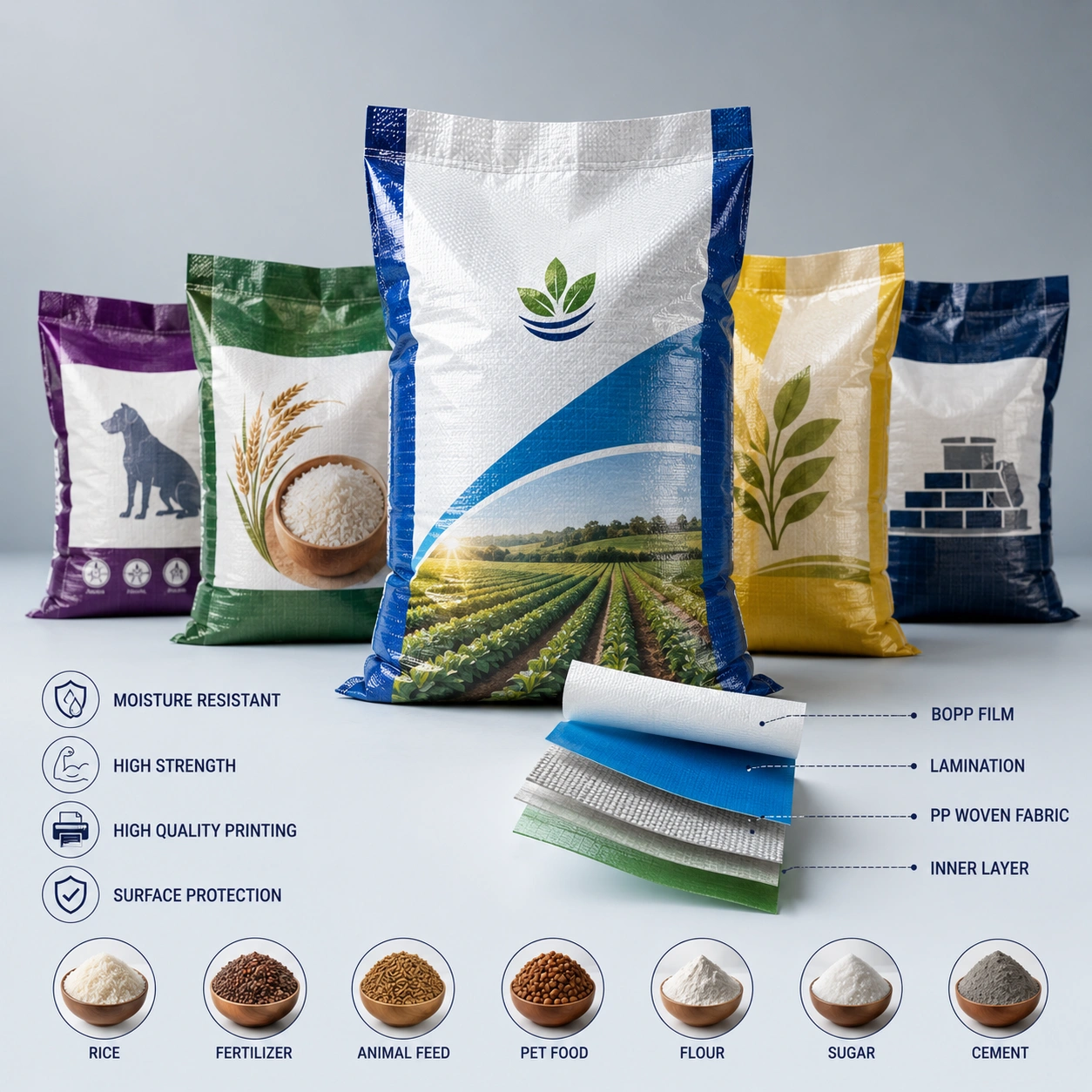
A BOPP Bag is a woven polypropylene packaging bag laminated with a Biaxially Oriented Polypropylene (BOPP) film. The woven polypropylene fabric provides structural strength, while the laminated BOPP film improves appearance, moisture resistance, surface protection, and print quality.
Unlike conventional woven polypropylene bags, laminated woven bags allow high-resolution photographic printing, making them ideal for branded retail packaging as well as industrial applications.
Because they combine durability with attractive presentation, BOPP packaging bags are widely used for packaging:
- Animal feed
- Pet food
- Fertilizers
- Seeds
- Rice
- Flour
- Sugar
- Cement
- Chemicals
- Minerals
- Agricultural products
Their versatility has made PP woven BOPP bags one of the fastest-growing packaging formats worldwide.
Why BOPP Bag Specifications Matter
Every packaging application places different demands on a bag. A 10 kg pet food bag requires different performance characteristics than a 50 kg cement bag or a fertilizer export sack.
The correct BOPP woven bag specifications determine:
- Load-bearing capacity
- Tear resistance
- Moisture protection
- Printing quality
- Stackability
- Export performance
- Product shelf appeal
Selecting specifications purely based on price may result in damaged goods, customer complaints, or unnecessary transportation losses.
Understanding the technical properties behind every BOPP Bag allows businesses to optimize both packaging performance and total packaging cost.
Understanding BOPP Bag Specifications
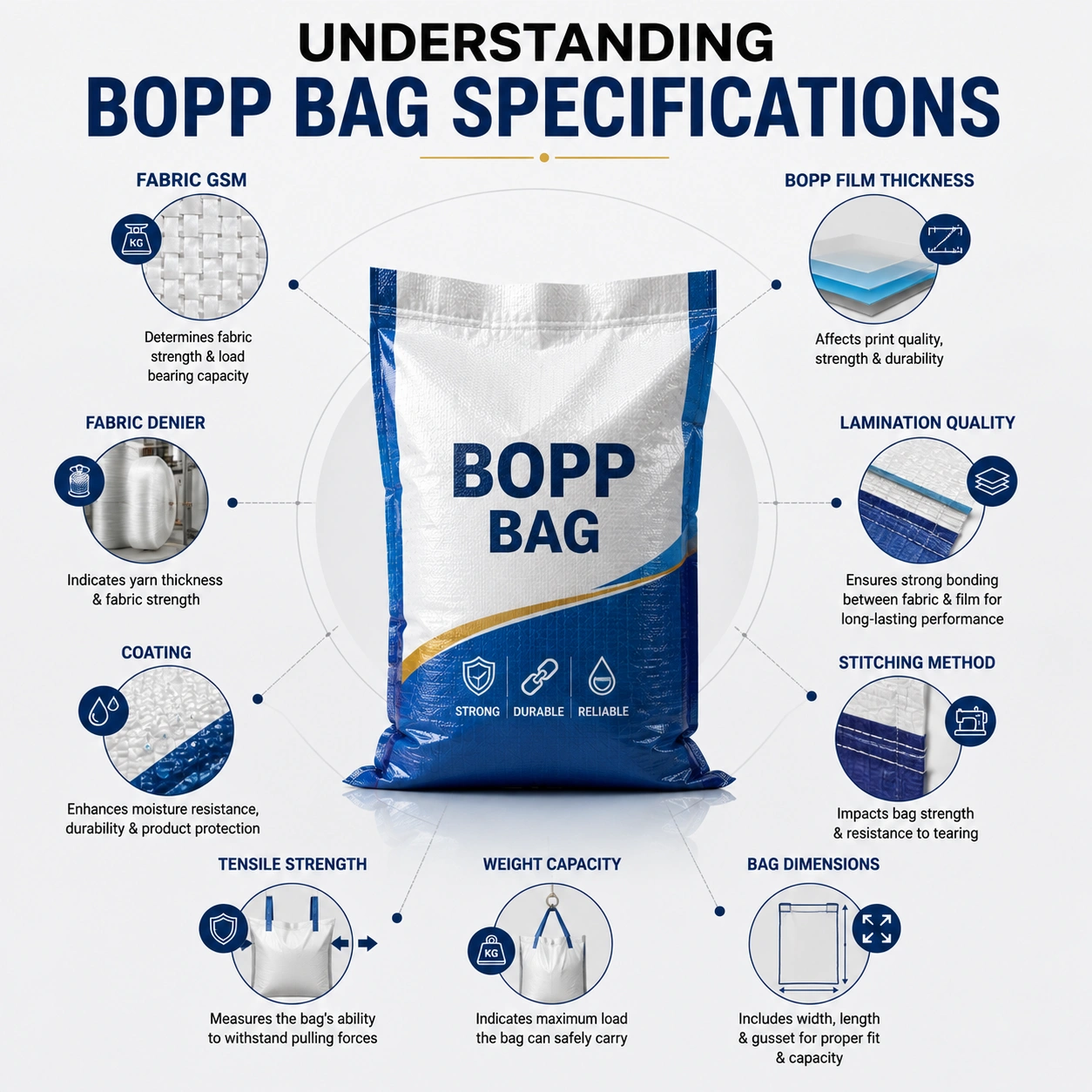
BOPP bag specifications refer to the measurable physical and mechanical characteristics that define how the bag performs under real-world conditions.
Some of the most important specifications include:
- Fabric GSM
- BOPP film thickness
- Fabric denier
- Lamination quality
- Coating
- Tensile strength
- Stitching method
- Bag dimensions
- Weight capacity
Each of these properties influences durability, appearance, and suitability for different industries.
Instead of focusing on only one specification, professional buyers evaluate the complete packaging system.
BOPP Film Thickness Explained
One of the most frequently discussed BOPP bag specifications is film thickness.
The laminated BOPP film forms the outer printable layer while also protecting the woven fabric beneath. Film thickness is generally measured in microns (µm), with different applications requiring different ranges depending on durability and printing requirements.
Thicker films generally provide:
- Improved puncture resistance
- Better gloss
- Enhanced scratch resistance
- Superior printing quality
However, increasing film thickness also increases material consumption and overall bag weight.
Packaging engineers therefore select the optimum thickness rather than simply choosing the thickest available option.
Retail food packaging often emphasizes appearance, while industrial BOPP bags prioritize mechanical performance.
What Is BOPP Bag GSM?
GSM (grams per square metre) measures the weight of the woven polypropylene fabric used to manufacture the bag.
BOPP bag GSM directly affects:
- Overall bag strength
- Load capacity
- Tear resistance
- Durability during handling
Higher GSM generally indicates a stronger woven structure capable of carrying heavier products. However, selecting unnecessarily high GSM may increase packaging costs without providing additional practical benefits.
Manufacturers therefore match GSM to the intended product weight, transportation method, and handling conditions.
When evaluating BOPP woven bag specifications, GSM should always be considered together with fabric weave, denier, and lamination rather than in isolation.
Understanding BOPP Bag Fabric
The woven polypropylene fabric forms the structural backbone of every laminated bag.
Thousands of polypropylene tapes are woven together to create a high-strength fabric capable of carrying significant loads while remaining lightweight.
Several factors influence BOPP bag fabric quality:
Weaving Density
Closely woven fabrics provide greater dimensional stability and improved load distribution.
Higher weave density often improves tensile performance while reducing fabric deformation during filling.
Polypropylene Tape Quality
Uniform tape production contributes to consistent strength throughout the woven fabric.
Variations in tape width or thickness may reduce overall bag performance even when GSM remains unchanged.
Fabric Construction
Different weaving patterns and manufacturing techniques are selected depending on whether the bag is intended for retail packaging, industrial packaging, or export applications.
Professional manufacturers carefully balance flexibility, strength, and cost to produce bags suitable for specific industries.
How Lamination Improves BOPP Bag Performance
Lamination transforms ordinary woven polypropylene bags into premium packaging solutions.
The BOPP film is bonded to the woven fabric using specialized lamination technology, creating a multi-layer packaging structure.
This laminated construction provides several important benefits.
First, it significantly improves print quality, allowing vibrant graphics, brand colours, and photographic images that attract consumers in retail environments.
Second, lamination enhances moisture resistance by creating an additional protective barrier between the packaged product and external humidity.
Third, it improves surface durability by reducing abrasion during transportation and storage.
Finally, lamination increases overall packaging aesthetics, making BOPP laminated bags suitable for premium consumer products where shelf appeal is important.
Why Buyers Should Evaluate Complete Specifications
Many buyers compare bags using only price or GSM, overlooking other critical performance factors.
In reality, BOPP film thickness, woven polypropylene fabric quality, lamination consistency, coating, tensile strength, stitching quality, and manufacturing precision all contribute to overall bag reliability.
A properly specified BOPP Bag reduces product loss, improves logistics performance, enhances brand presentation, and supports efficient packaging operations across global supply chains.
For businesses involved in export packaging, selecting the correct specifications from the beginning often results in lower total packaging costs despite a slightly higher initial purchase price.
BOPP Bag Coating Explained
One of the most important yet often overlooked BOPP bag specifications is the coating applied during manufacturing. While the laminated BOPP film provides excellent printability and surface protection, additional coatings improve sealing performance, moisture resistance, and product protection depending on the packaging application.
The coating acts as an extra protective layer between the woven polypropylene fabric and the packaged product. It helps reduce moisture penetration, improves resistance to dust, and increases the durability of the bag during transportation and storage.
The type of coating selected depends on the product being packed. Food products, fertilizers, animal feed, chemicals, and industrial materials each have different packaging requirements, making coating selection an important part of overall BOPP bag manufacturing specifications.
Types of BOPP Bag Coatings
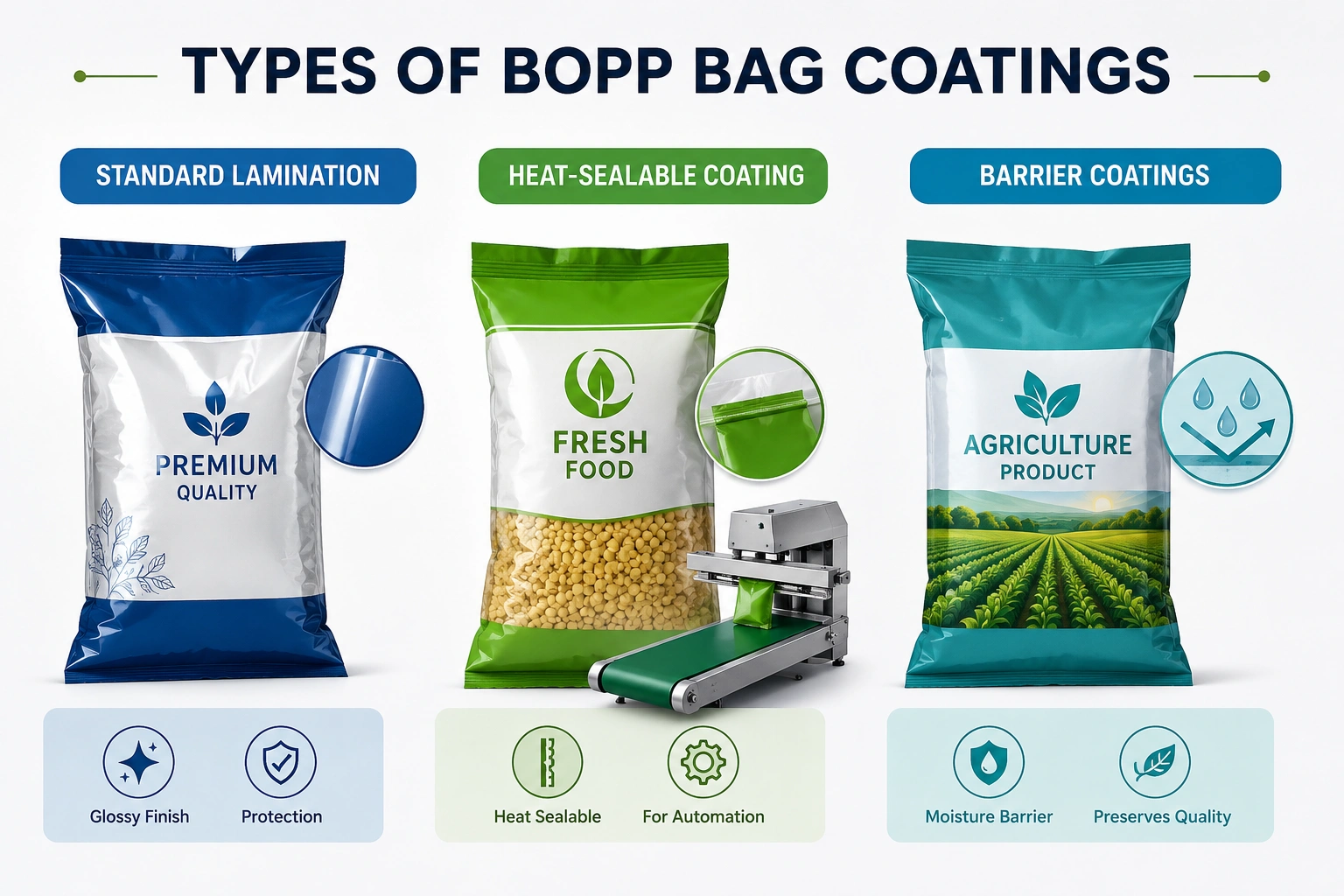
Although manufacturing methods vary between producers, several coating options are commonly used across the packaging industry.
Standard Lamination
Standard BOPP lamination provides an attractive glossy or matte finish while protecting printed graphics from abrasion and handling damage. It is widely used for retail packaging where visual presentation is a priority.
This coating also improves resistance to light moisture and everyday handling during transportation.
Heat-Sealable Coating
Some BOPP packaging bags include heat-sealable coatings that allow automatic filling and sealing on high-speed packaging lines.
These coatings eliminate the need for stitching in certain applications, providing cleaner package appearance and improved sealing consistency.
They are commonly used for premium food products and automated industrial packaging systems.
Barrier Coatings
For products requiring greater protection from humidity or environmental exposure, barrier coatings provide an additional defence against moisture transfer.
Food grade BOPP bags, agricultural products, seeds, and certain chemical products often benefit from enhanced barrier performance to preserve product quality during storage and export.
BOPP Bag Tensile Strength
Tensile strength measures the amount of force a bag can withstand before the woven fabric begins to fail. It is one of the most important indicators of packaging reliability because bags experience significant stress during filling, stacking, lifting, transport, and unloading.
High tensile strength depends on several manufacturing factors working together rather than a single specification.
These include:
- Polypropylene tape quality
- Fabric weave density
- BOPP bag GSM
- Lamination quality
- Stitching strength
- Manufacturing consistency
A properly engineered BOPP Bag distributes weight evenly across the woven fabric, reducing the likelihood of tearing during handling.
Industrial BOPP bags used for cement, fertilizers, minerals, and animal feed generally require higher tensile performance than lightweight retail packaging.
Understanding BOPP Bag Weight Capacity
Another critical specification is the maximum load the bag is designed to carry safely.
BOPP bag weight capacity is influenced by:
- Fabric GSM
- Fabric denier
- Bag dimensions
- Stitching method
- Tensile strength
- Product density
- Safety factor
For example, a bulky agricultural product and a dense mineral product may weigh the same but place different stresses on the packaging because of differences in volume and load distribution.
Professional manufacturers design each bag specifically for its intended application rather than relying solely on product weight.
Selecting the correct weight capacity improves safety throughout storage, transportation, and warehouse handling.
BOPP Bag Manufacturing Specifications
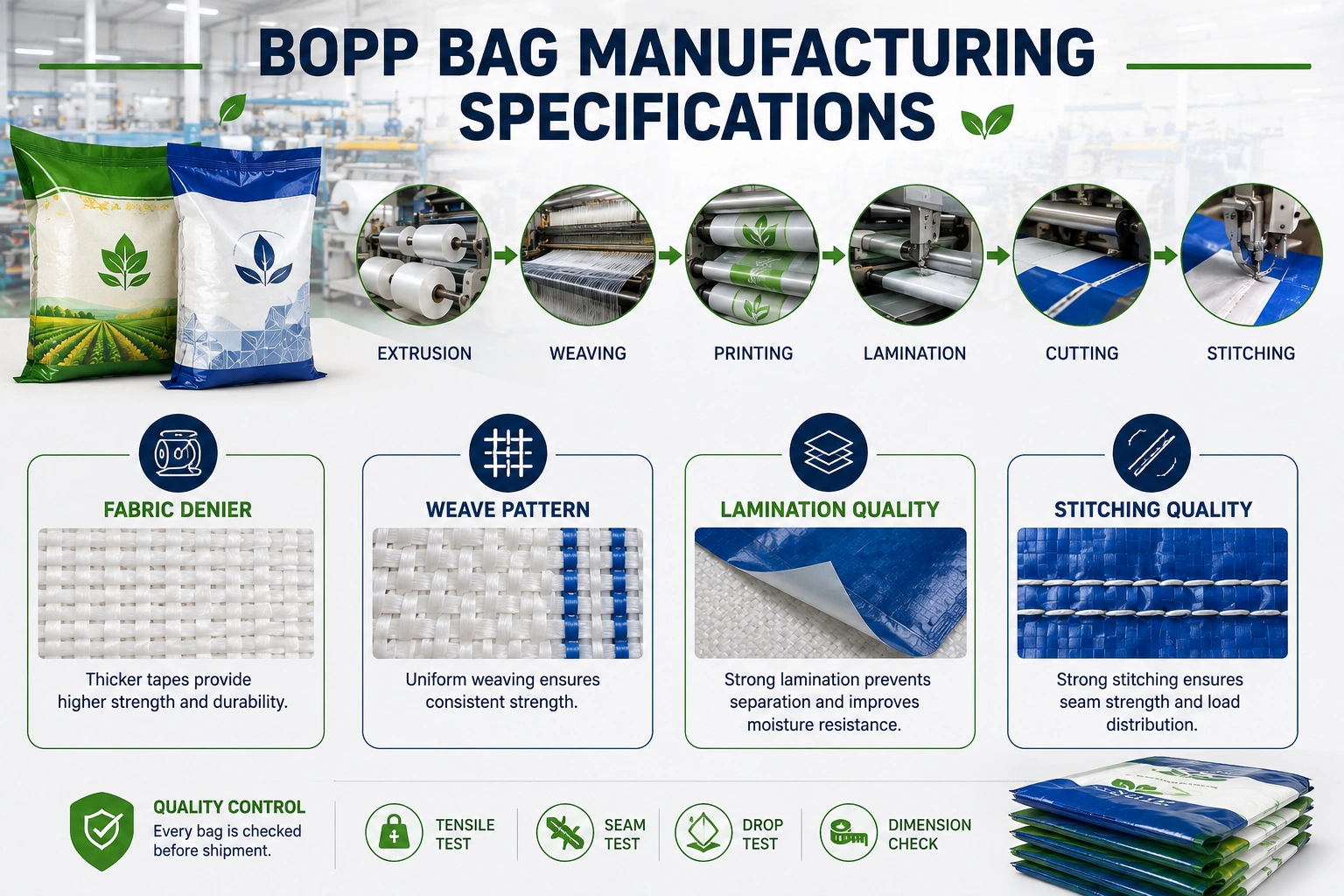
Producing high-quality BOPP laminated bags requires careful control throughout every stage of manufacturing.
The process typically includes extrusion of polypropylene tapes, weaving of the fabric, BOPP film printing, lamination, cutting, stitching, and quality inspection.
Several manufacturing specifications influence final product performance:
Fabric Denier
Denier measures the thickness of individual polypropylene tapes used in weaving.
Higher denier tapes generally contribute to increased tensile strength, although they must be balanced with fabric weight and flexibility.
Weave Pattern
Uniform weaving ensures consistent strength throughout the bag.
Irregular weaving may create weak areas that reduce durability under heavy loads.
Lamination Quality
Proper bonding between the woven fabric and BOPP film improves appearance while preventing film separation during transportation and repeated handling.
Consistent lamination also enhances moisture resistance and printing durability.
Stitching Quality
Bottom stitching and side seams are among the most heavily stressed areas of a filled bag.
High-quality stitching distributes loads evenly while reducing the likelihood of seam failure during lifting or stacking.
Professional quality control includes seam testing before bags are released for shipment.
BOPP Bag Specification Comparison
The table below provides a simplified comparison of common BOPP woven bag specifications for different packaging applications.
| Application | Typical Fabric Strength | Film Thickness | Recommended Performance |
|---|---|---|---|
| Food Products | Medium | Medium | Excellent printing and moisture protection |
| Animal Feed | High | Medium | Strong tensile strength and durability |
| Fertilizers | High | Medium to High | Moisture resistance and heavy-load performance |
| Cement | Very High | Medium | Maximum tensile strength and seam durability |
| Seeds | Medium | Medium | Print quality and barrier protection |
| Industrial Chemicals | High | High | Chemical resistance and export durability |
Actual specifications should always be selected according to product characteristics, handling conditions, and customer requirements.
Choosing the Right BOPP Bag for Your Industry
Different industries prioritise different performance characteristics, making specification selection highly application-specific.
Food grade BOPP bags require excellent hygiene, print quality, and moisture protection while complying with food-contact regulations.
Animal feed BOPP bags emphasise durability because they frequently experience repeated handling throughout the supply chain.
Fertilizer BOPP bags must resist moisture and mechanical stress during storage and transportation, particularly in humid climates.
Cement BOPP bags require exceptional tensile strength and seam integrity because they routinely carry heavy loads under demanding conditions.
Export-oriented businesses often choose laminated woven bags with enhanced moisture resistance and superior printing to maintain product quality throughout international logistics.
Selecting specifications based on actual application requirements results in better packaging performance and improved cost efficiency.
Practical Tips for Buyers
Choosing a BOPP Bag should involve more than comparing dimensions or purchase price alone.
Evaluate the complete specification by reviewing film thickness, BOPP bag GSM, fabric quality, coating type, tensile strength, stitching, and intended weight capacity together.
Request technical data sheets and quality certifications from suppliers before placing large production orders. Conducting small-scale performance trials under real operating conditions also helps confirm that the selected bag meets your packaging requirements.
Businesses that invest time in specification evaluation generally experience fewer packaging failures, reduced product losses, and improved customer satisfaction.
How to Choose the Right BOPP Bag Manufacturer and Supplier
Selecting the correct bag specifications is only half of the purchasing decision. The expertise and manufacturing capabilities of your supplier play an equally important role in ensuring consistent quality, timely delivery, and long-term packaging performance.
An experienced BOPP bag manufacturer should be able to recommend specifications based on your product, filling process, storage conditions, and transportation requirements rather than simply supplying a standard bag. This consultative approach helps businesses avoid over-engineering or under-specifying their packaging.
Before placing large orders, request technical data sheets, product samples, and information about quality control procedures. Reliable manufacturers perform routine testing on woven fabric, lamination, stitching, tensile strength, and dimensional accuracy to ensure every production batch meets customer expectations.
If your products are exported internationally, confirm that the supplier has experience producing BOPP export bags designed to withstand extended storage, container shipping, and varying climate conditions.
Quality Standards and Certifications
High-quality BOPP packaging bags are manufactured according to established quality management systems and industry standards. Although specifications vary by application and destination market, manufacturers generally follow strict quality procedures throughout production.
Many leading facilities operate under ISO 9001 quality management systems, which help maintain consistency in manufacturing, inspection, and customer satisfaction. Food grade BOPP bags may also require compliance with food-contact regulations depending on the country of use.
Quality assurance typically includes checks for:
- Fabric consistency
- Film adhesion
- Printing accuracy
- Seam strength
- Bag dimensions
- Weight tolerance
- Visual appearance
Routine testing ensures that each bag performs reliably during filling, transportation, storage, and final use.
Sustainability and Recyclability
Sustainability has become an increasingly important consideration for businesses worldwide. Fortunately, woven polypropylene bags laminated with BOPP film can contribute to more responsible packaging practices when managed correctly.
Polypropylene is recyclable in many regions, and advances in manufacturing have improved material efficiency while maintaining high performance. Modern production processes also focus on reducing material waste, improving energy efficiency, and optimizing raw material usage.
The long service life of laminated woven bags is another sustainability advantage. Their durability allows them to withstand demanding transportation and storage conditions, reducing the likelihood of packaging failures and unnecessary product loss.
As recycling infrastructure continues to improve globally, businesses are placing greater emphasis on selecting packaging that balances performance, appearance, and environmental responsibility.
BOPP Packaging Trends in 2026
Packaging technology continues to evolve as manufacturers respond to changing customer expectations, automation, and sustainability goals.
One major trend is the increasing use of high-definition rotogravure and digital printing techniques. These technologies allow brands to produce vibrant, photo-quality graphics that enhance shelf appeal while maintaining excellent print durability.
Demand for lighter yet stronger BOPP woven bag specifications is also increasing. Advances in woven polypropylene fabric engineering enable manufacturers to optimise strength without significantly increasing material consumption.
Automation is another important development. Many packaging facilities now use automated inspection systems that monitor printing quality, lamination consistency, and stitching accuracy throughout production, improving both efficiency and product reliability.
Smart packaging features such as QR codes, batch tracking, anti-counterfeit printing, and traceability markings are becoming more common, particularly for premium food, agricultural, and export products.
These innovations continue to strengthen the role of BOPP laminated bags as one of the most versatile packaging solutions available today.
Why the Right Specifications Improve Business Performance
Packaging is often viewed as a cost, but in reality it is an investment that protects products, strengthens brand identity, and supports supply chain efficiency.
Choosing the appropriate BOPP bag specifications reduces product damage during transport, improves warehouse handling, enhances retail presentation, and lowers the risk of customer complaints.
For exporters, high-quality laminated woven bags help products withstand long shipping journeys and changing environmental conditions. For retailers, attractive printing and durable packaging improve shelf visibility and customer confidence. Industrial users benefit from stronger bags that reduce breakage during filling and distribution.
By considering film thickness, GSM, fabric construction, coating, tensile strength, stitching, and weight capacity together, businesses can select packaging that delivers long-term value rather than focusing solely on purchase price.
Industry Guidance and Technical References
Although individual product specifications vary between manufacturers, packaging performance should always be supported by recognised quality management practices and internationally accepted standards.
The International Organization for Standardization (ISO) publishes globally recognised standards covering quality management systems, manufacturing consistency, and process control. These standards help manufacturers maintain repeatable production quality and continuous improvement.
Businesses should also request technical data sheets, material specifications, and quality certifications from suppliers before finalising packaging decisions. Reviewing this information ensures the selected BOPP Bag is appropriate for the intended application.
Conclusion
Understanding BOPP Bag specifications is essential for selecting packaging that performs reliably throughout the entire supply chain. Film thickness, fabric GSM, woven polypropylene construction, coating, lamination, tensile strength, and weight capacity all work together to determine durability, product protection, print quality, and transportation performance. Evaluating these specifications as a complete system helps businesses reduce packaging failures, improve operational efficiency, and achieve better long-term value.
If you're looking for high-quality custom packaging solutions, Oberon Polypack offers a wide range of BOPP laminated bags designed for food, agriculture, industrial, and export applications. Explore our BOPP Packaging Solutions to learn more, request technical guidance, or obtain a customised quotation tailored to your packaging requirements.
Frequently Asked Questions
1. What are the most important BOPP bag specifications?
The most important BOPP bag specifications include film thickness, fabric GSM, woven polypropylene fabric quality, lamination, coating, tensile strength, stitching quality, bag dimensions, and weight capacity. Together, these factors determine the overall performance and durability of the bag.
2. How does BOPP film thickness affect bag performance?
BOPP film thickness influences print quality, scratch resistance, puncture resistance, and surface durability. Selecting the correct thickness depends on the intended application rather than simply choosing the thickest available film.
3. Why is GSM important in BOPP bags?
BOPP bag GSM measures the weight of the woven polypropylene fabric. Higher GSM generally provides greater strength and durability, but the ideal value depends on product weight, handling conditions, and packaging requirements.
4. Are BOPP laminated bags recyclable?
BOPP laminated bags are manufactured primarily from polypropylene, which is recyclable in many regions where suitable recycling facilities exist. Businesses should follow local recycling regulations and waste management practices.
5. Which industries commonly use BOPP bags?
BOPP packaging bags are widely used for animal feed, pet food, fertilizers, cement, seeds, rice, flour, sugar, chemicals, minerals, and many other industrial and agricultural products because they combine strength, moisture resistance, and excellent print quality.