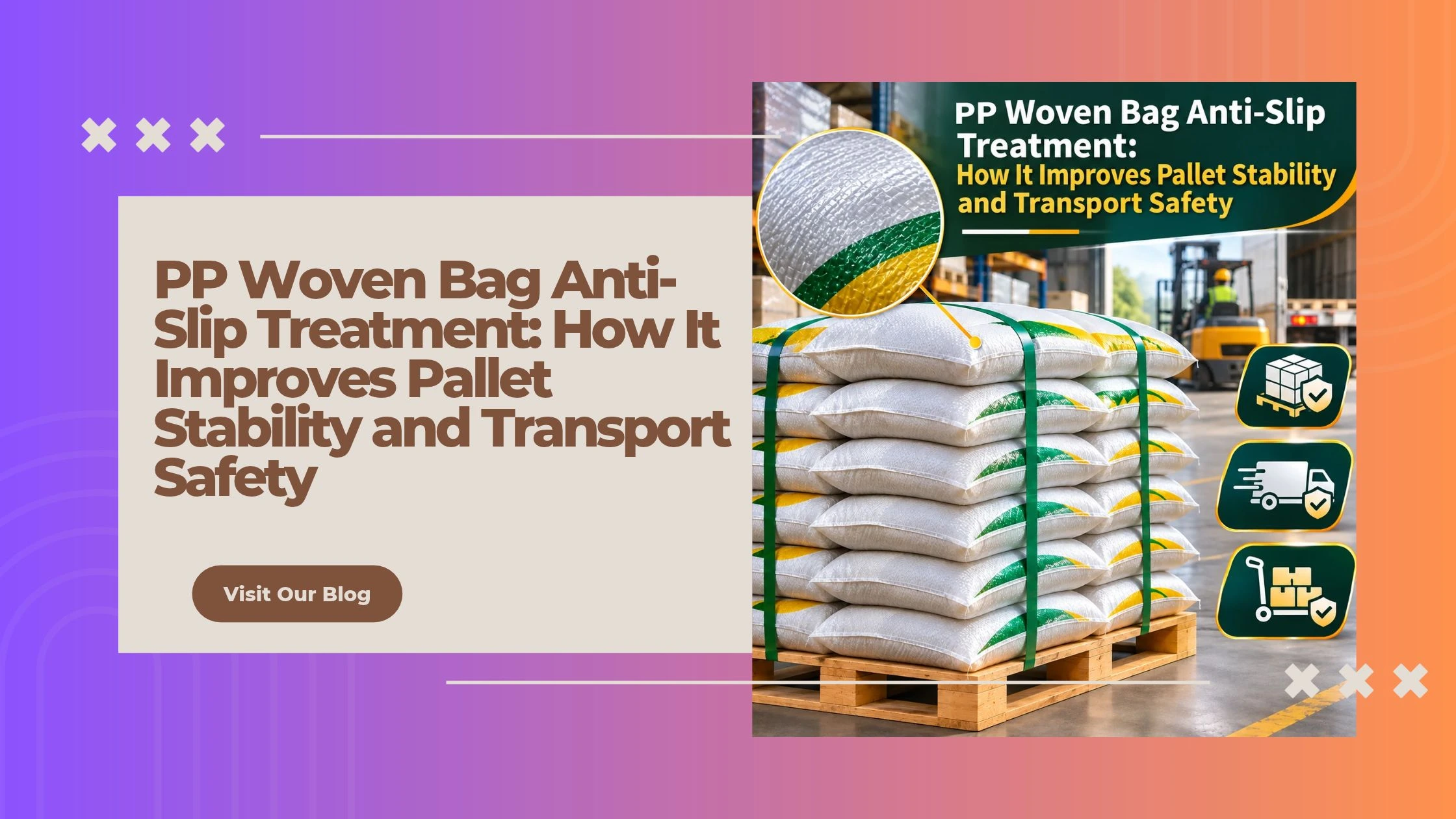
When filled bags shift during stacking, warehouse handling or transportation, the result can be damaged packaging, product spillage, additional handling and potential safety risks. One factor that can influence this problem is the surface friction of the bags.
PP woven bag anti-slip treatment refers to a surface-related feature intended to increase resistance to sliding under suitable conditions. It may help improve the interaction between adjacent bags, but it cannot guarantee pallet stability by itself. Bag construction, product weight, stacking pattern, pallet condition and transport forces must also be considered.
Quick answer: Anti-slip treatment on PP woven bags is intended to modify surface interaction so that bags may resist sliding more effectively. Its value depends on the bag material, contact surfaces and operating conditions. Buyers should evaluate the complete filled-bag and pallet configuration before deciding whether treatment is necessary.
What Is Anti-Slip Treatment for PP Woven Bags?
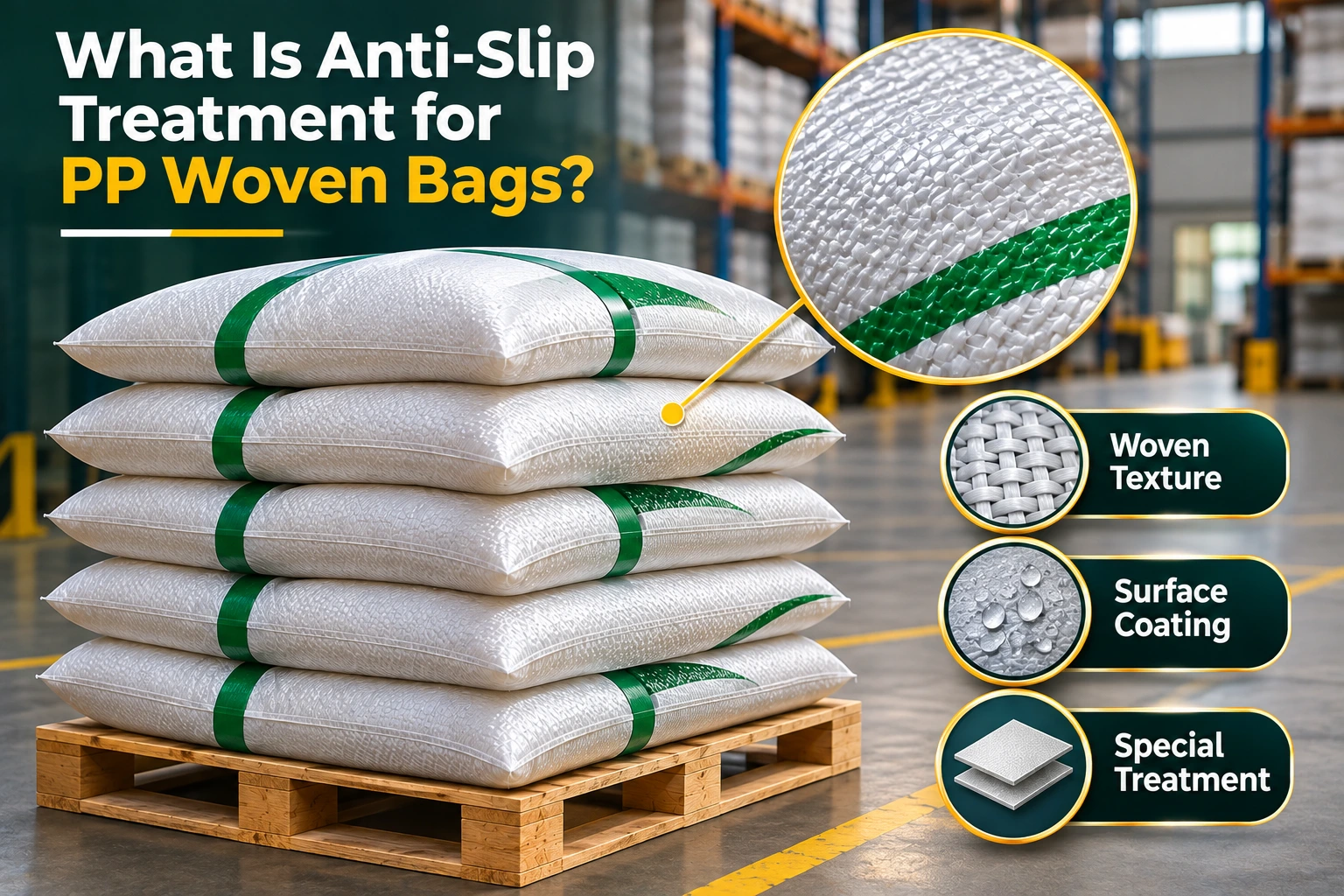
PP woven bags are made from polypropylene tapes woven together to form a flexible packaging fabric. They are used for agricultural products, fertilisers, animal feed, industrial powders, granules and other bulk materials.
Anti-slip treatment describes a surface feature or treatment intended to increase resistance to movement between contacting surfaces. Depending on the product design, surface behaviour may be influenced by fabric texture, weaving configuration, coatings or other manufacturing features.
These options should not be treated as interchangeable. A textured woven surface is not necessarily the same as a chemically treated or coated surface, and each construction can behave differently.
Oberon Polypack's PP woven bag product page lists flat or anti-slip weaving among its product features. Buyers should confirm the precise construction, available options and performance requirements with the company before specifying a particular solution.
The objective is not simply to make a bag feel rougher. It is to achieve suitable sliding resistance without creating other problems during filling, conveying, handling, stacking or packaging operations.
Why Does Pallet Stability Matter for PP Woven Bags?
Pallet stability describes how well a loaded pallet maintains its intended arrangement during storage, handling and transportation.
When bags move relative to one another, the load can become uneven. This may increase the likelihood of leaning stacks, damaged bags, product leakage or the need for re-stacking. The actual risk depends on the load configuration and handling conditions.
A stable pallet load is important for several reasons:
- It helps maintain an organised arrangement during warehouse storage and movement.
- It reduces the likelihood of bags shifting into unsafe positions.
- It helps protect packaging from avoidable impacts and abrasion.
- It can reduce interruptions caused by damaged or displaced loads.
These benefits depend on the complete packaging system. Anti-slip bag surfaces may contribute to stability, but safe stacking, suitable pallets, load restraint and correct handling remain essential.
Warehouse teams should also follow applicable workplace requirements. The US Occupational Safety and Health Administration (OSHA), for example, recommends that stored bags and other materials be stacked and secured to prevent sliding or collapse.
How Does Anti-Slip Treatment Affect Bag Surface Friction?
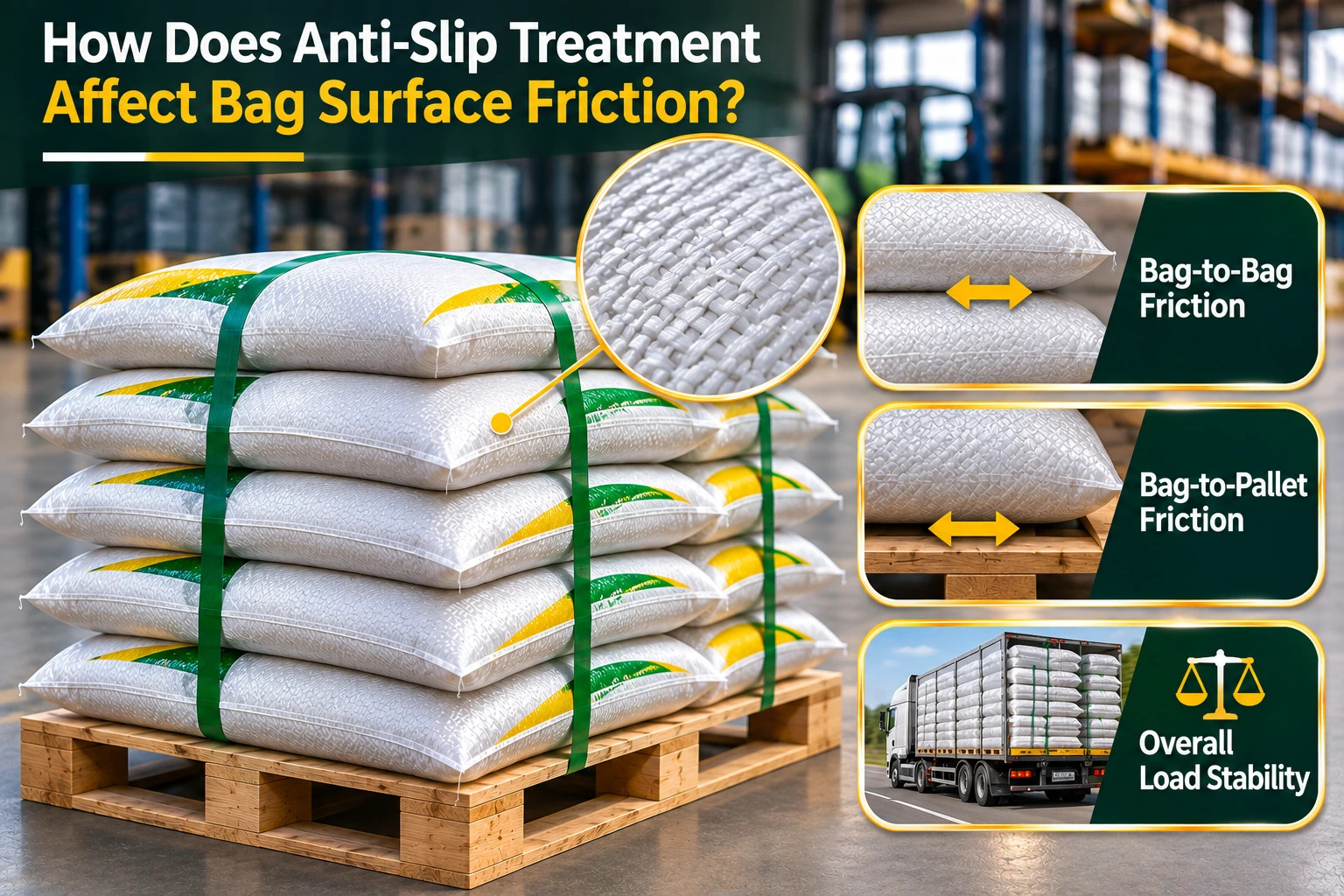
Friction is the resistance that develops when two surfaces contact one another and movement is attempted. In packaging applications, it can influence how easily one bag slides over another or how a bag moves against a supporting surface.
The relationship between friction and stability is useful, but it requires careful interpretation.
Friction between adjacent bags
When bags are stacked, their contacting surfaces influence their tendency to slide relative to one another. Surface texture, material composition, contamination, contact pressure and the shape of the filled bags can all affect the interaction.
An anti-slip surface feature may improve resistance to sliding in a particular configuration. However, its effect must be verified for the actual bag material and application.
Friction between the bag and the pallet
The contact between a bag and a pallet is different from the contact between two bags. A surface feature that improves bag-to-bag interaction may not produce the same result against wood, plastic or another pallet material.
Buyers should therefore identify where movement occurs before selecting a treatment. If bags remain stable against one another but the bottom layer moves across the pallet, the relevant contact surface may be the more important factor.
Why surface friction alone is insufficient
Filled bags change shape as products settle. Their contact area, centre of mass and load distribution can also vary. During transport, acceleration, braking, turning and vibration can introduce forces that are not represented by a simple surface-friction measurement.
The practical conclusion is that higher friction does not automatically mean a stable pallet. The full load arrangement must be assessed under representative conditions.
Anti-Slip Treated vs Untreated PP Woven Bags
The choice between treated and untreated surfaces should be based on the actual packaging problem rather than an assumption that one option is always superior.
| Comparison factor | Anti-slip treated or designed surface | Untreated surface |
|---|---|---|
| Surface characteristics | Intended to modify resistance to sliding | Depends on the original fabric and finish |
| Bag-to-bag interaction | May improve sliding resistance under suitable conditions | Depends on the contacting materials and load |
| Pallet stability | Can contribute to stability as part of a complete system | Depends on bag design, stacking and restraint |
| Handling requirements | Still requires correct handling and stacking | Still requires correct handling and stacking |
| Filling and conveying | Must be checked for compatibility with equipment | Must also be checked for compatibility |
| Performance verification | Evaluate against the intended application | Evaluate against the intended application |
| Selection basis | Consider when surface sliding is a demonstrated concern | May be sufficient when existing performance meets requirements |
The comparison is qualitative. Actual results depend on the construction and operating conditions, so no specific improvement should be assumed without supporting test data.
What Factors Affect PP Woven Bag Pallet Stability?
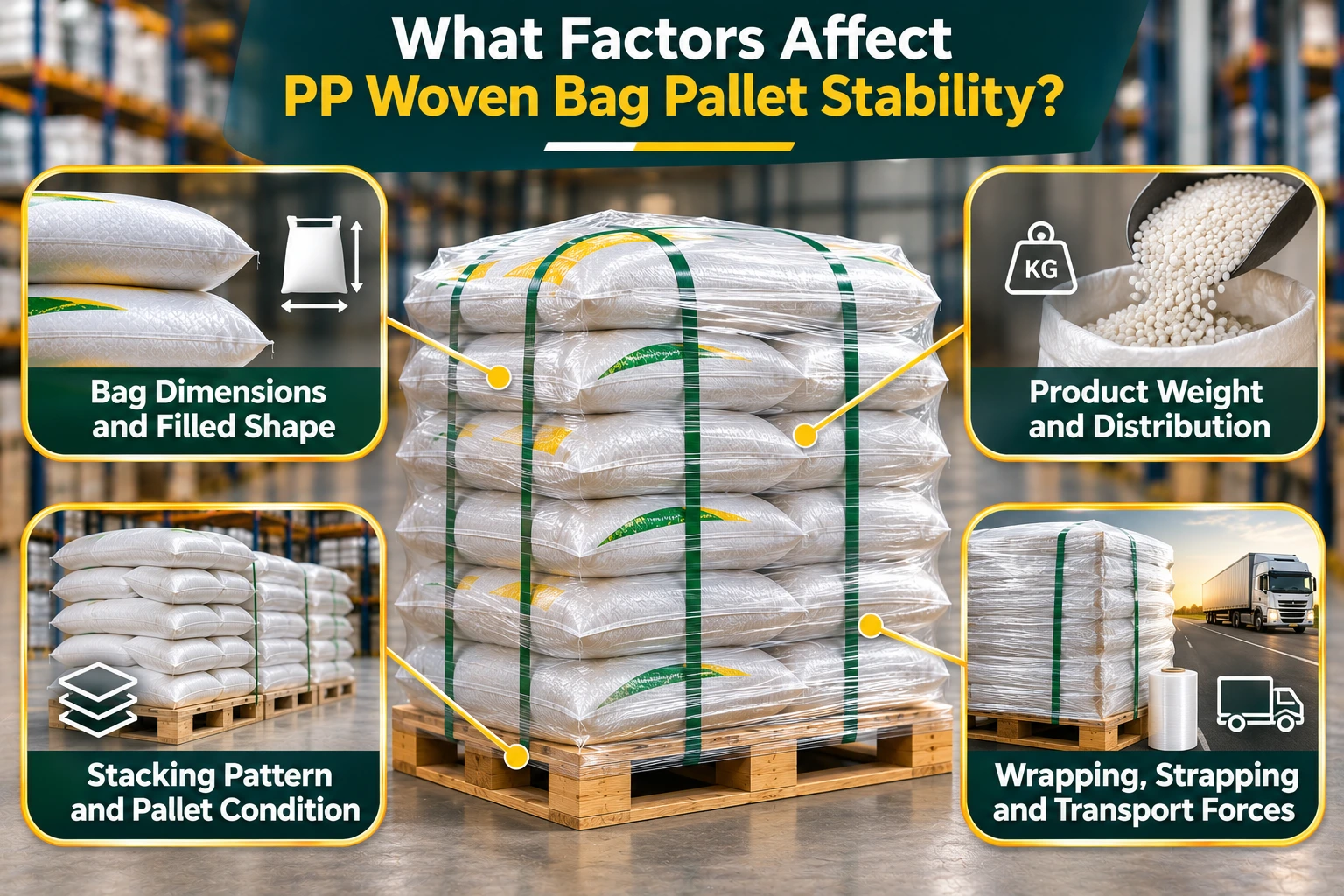
A pallet load is a system made up of the product, bags, pallet, stacking arrangement and any restraint materials. Each part can influence the final result.
Bag dimensions and filled shape
Bag width, length, gussets and filling level influence how bags sit against one another. Inconsistent dimensions or uneven filling can create gaps and unstable contact points.
A well-matched bag specification helps produce a more consistent stacking arrangement. However, the ideal dimensions depend on the product, target fill weight and pallet configuration.
Product weight and distribution
Product density and flow characteristics affect how a bag settles after filling. A bag filled unevenly may lean or bulge, while differences between individual bags can produce an inconsistent pallet profile.
The outer bag construction and the way the contents settle should therefore be evaluated together.
Stacking pattern and pallet condition
Stacking patterns influence how weight is distributed across the pallet. Alignment, interlocking arrangements where appropriate, overhang and the condition of the pallet all matter.
Damaged pallets, uneven supporting surfaces and unsuitable stack arrangements can undermine stability even when the bags have suitable surface characteristics.
Wrapping, strapping and transport forces
Stretch wrapping, strapping or other restraint methods may help secure a load when correctly selected and applied. The appropriate method depends on the packaging configuration, transport route and applicable handling requirements.
Forklift movement, vehicle braking, cornering and road vibration can all affect a pallet load. A configuration that remains stable while stationary may behave differently during transportation.
For demanding distribution conditions, a qualified packaging or logistics specialist may recommend formal load-unit testing. The EUMOS quality standards overview describes EUMOS 40509 as a method for evaluating load-unit rigidity under dynamic conditions.
Which Applications May Benefit from Anti-Slip PP Woven Bags?
Anti-slip PP woven bags may be worth evaluating wherever sliding between bags is a demonstrated concern. The requirement should be established by examining the product, pallet arrangement and distribution process.
Agricultural products and fertilisers are commonly supplied in stacked woven sacks. Bag shape, product settling and storage conditions can influence the stability of these loads.
Animal feed and grain packaging may also require consistent bag dimensions and suitable stacking arrangements, particularly where multiple layers are handled by forklifts.
Industrial powders, granules and selected construction materials can produce dense or unevenly shaped loads. Their behaviour depends on the product and filling process, so the bag specification should reflect the actual application.
Not every product requires anti-slip treatment. Some existing bag constructions may already provide adequate performance when used with suitable pallets, stacking patterns and restraint methods.
Oberon Polypack provides PP woven bags for agricultural, industrial and other bulk-packaging applications. Buyers should discuss the intended use and confirm whether a suitable anti-slip option is available for their required specification.
How to Choose the Right Anti-Slip PP Woven Bag
The best selection process begins by identifying the actual problem. A request for an anti-slip bag is more useful when it explains where and how movement occurs.
First, determine whether the bags slide against one another, move across the pallet or become unstable because of inconsistent filling and stacking. Inspect the current load before changing the bag specification.
Next, review the product type, filled weight, bag dimensions, construction and pallet arrangement. Confirm whether the proposed surface feature is compatible with the required filling, conveying and handling processes.
Ask the supplier what surface options are available and what evidence supports their suitability. If the treatment or construction is intended to address a specific sliding problem, agree on how that performance will be evaluated.
Finally, test representative filled bags and pallet loads before approving bulk production. Changes to the bag surface, dimensions, product weight or restraint system may require reassessment.
How to Evaluate Anti-Slip Performance Before Bulk Ordering
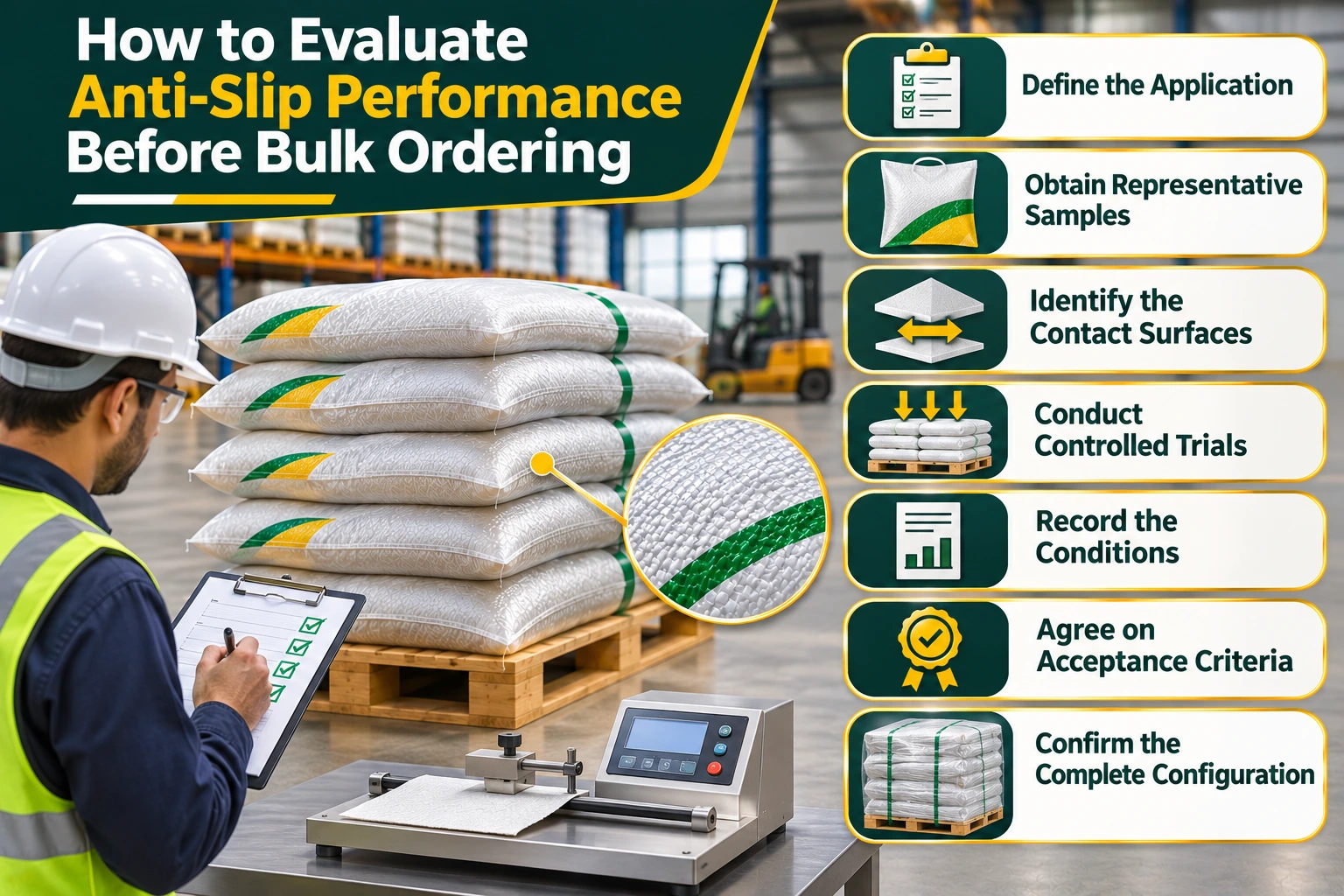
A structured evaluation helps determine whether the proposed bag construction is appropriate for the intended operation.
- Define the application. Record the product, target fill weight, bag dimensions, pallet type, stacking pattern and transport conditions.
- Obtain representative samples. Request samples matching the proposed bag construction and surface specification.
- Identify the relevant contact surfaces. Assess bag-to-bag movement and bag-to-pallet movement separately where necessary.
- Conduct controlled trials. Use representative filled bags and the intended pallet configuration. Observe sliding, deformation and changes in load arrangement.
- Record the conditions. Document the sample construction, load configuration, test method and observations.
- Agree on acceptance criteria. Determine what constitutes acceptable performance before comparing samples or approving an order.
- Confirm the complete configuration. Review whether wrapping, strapping or other restraint is required alongside the selected bag.
Where a quantitative friction measurement is relevant, ASTM D1894-24 provides a test method for determining static and kinetic coefficients of friction for plastic film and sheeting. See the official ASTM D1894 standard page. Its scope is plastic film and sheeting; it should not automatically be treated as a complete pallet-stability test or assumed to apply directly to every woven bag construction.
For transport-critical loads, the assessment may need to extend beyond material friction to the rigidity and movement of the complete palletised load.
Common Mistakes When Using Anti-Slip PP Woven Bags
A common mistake is assuming that anti-slip treatment eliminates the need for load restraint. Surface friction cannot replace a properly designed and secured pallet configuration.
Another is ignoring the pallet condition. Damaged boards, uneven support and unstable stacking can introduce movement that a bag surface feature cannot correct.
Inconsistent filling is another source of difficulty. Bags with different shapes or fill levels may not support one another evenly, even if they have similar surface characteristics.
Buyers should also avoid approving a new surface construction without testing it on the actual filling and handling process. A change that affects sliding resistance may also influence conveying, separation or other operational characteristics.
Finally, do not assume that a simple manual sliding check proves transport safety. It can help identify obvious differences, but it does not reproduce all forces experienced during shipping.
Buyer Checklist for Anti-Slip PP Woven Bags
Use the following table when preparing a packaging specification or discussing a potential surface option with a supplier.
| Buyer requirement | What to confirm | Why it matters |
|---|---|---|
| Product and fill weight | Product characteristics and target bag weight | Influences shape and load behaviour |
| Bag specifications | Dimensions, construction and closure | Affects filling and stacking consistency |
| Surface requirement | Location and nature of the sliding problem | Establishes whether a surface option may help |
| Pallet configuration | Pallet type, stack pattern and load arrangement | Influences complete-load stability |
| Transport conditions | Handling, vibration and distribution route | Helps define realistic evaluation conditions |
| Restraint method | Wrapping, strapping or other securing measures | Contributes to load containment |
| Sample approval | Trial method and acceptance criteria | Reduces uncertainty before bulk ordering |
How to Discuss Anti-Slip Requirements with a PP Woven Bag Manufacturer
When requesting a quotation, explain the application rather than asking for an anti-slip treatment without context.
Provide the product type, filled bag weight, required dimensions, current stacking problem, pallet configuration and transport conditions. Include photographs of the current arrangement if they help explain where movement occurs.
Ask the manufacturer to clarify the available surface options, relevant construction details and any supporting test information. Confirm whether the proposed option has been evaluated for the intended use and whether sample trials are recommended.
Oberon Polypack's PP woven bag product page lists anti-slip weaving among its features. For specifications, availability and application advice, contact the company through its official enquiry page.
Conclusion
PP woven bag anti-slip treatment may help improve resistance to sliding where surface interaction is a contributing factor in pallet movement. However, reliable pallet stability depends on more than friction. Bag dimensions, product distribution, stacking patterns, pallet condition, restraint methods and transportation forces must all be considered.
Before placing a bulk order, identify the actual stability problem, discuss suitable surface options with the supplier and evaluate representative filled bags under realistic conditions. This provides a stronger basis for selecting packaging than relying on a general anti-slip claim.
Oberon Polypack can be contacted to discuss PP woven bag specifications and the available surface options for your application. Share your product, bag dimensions, pallet arrangement and transport requirements to begin the discussion.
Frequently Asked Questions
1. What is anti-slip treatment for PP woven bags?
It refers to a surface-related feature intended to increase resistance to sliding between contacting surfaces. The effect depends on the bag construction and operating conditions, and the precise treatment or surface design should be confirmed with the manufacturer.
2. Do anti-slip PP woven bags prevent bags from sliding on pallets?
Not in every situation. They may improve resistance to sliding, but pallet condition, bag shape, stacking, restraint methods and transport forces also affect stability. The complete load should be evaluated under representative conditions.
3. What is the difference between treated and untreated PP woven bags?
A treated or specially designed surface is intended to modify surface interaction. An untreated bag relies on its original fabric and finish. Neither option is universally superior; suitability depends on the product and packaging configuration.
4. How can I test the sliding resistance of PP woven bags?
Start by defining the contact surfaces and intended conditions. Compare representative samples using an appropriate controlled method. Where relevant, use a suitable friction test or obtain specialist testing. A manual check alone cannot establish full transport safety.
5. Which industries may benefit from anti-slip woven bags?
Agriculture, fertiliser, animal feed, grain, construction and selected industrial applications may benefit when sliding is a demonstrated problem. The need depends on the product, bag construction and pallet configuration.
6. Does anti-slip treatment replace pallet wrapping or strapping?
No. Surface friction and load restraint serve different purposes. Appropriate wrapping, strapping or other securing methods may still be needed to keep the complete pallet load stable during handling and transport.
7. What should I consider before ordering anti-slip PP woven bags in bulk?
Define the product and filled weight, bag dimensions, current stability issue, pallet arrangement and transport conditions. Confirm the available surface options, test representative samples and agree on acceptance criteria before approving bulk production.