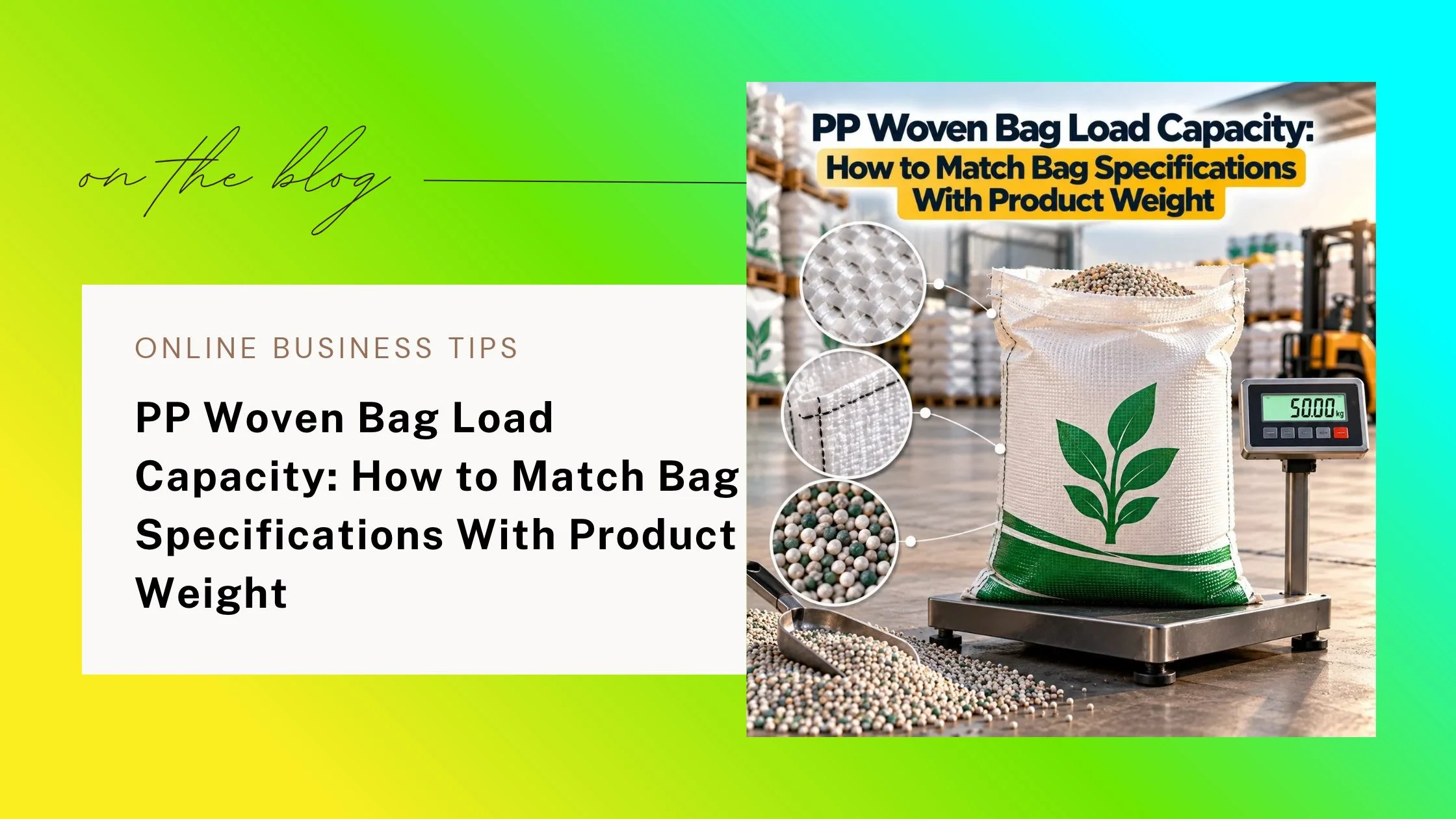
A PP woven bag may look simple, but choosing one for a heavy product is a little more involved than asking, “How many kilos can it hold?” A bag carrying 25 kg of grain has a very different job from one carrying 50 kg of fertilizer, cement, minerals or another dense bulk product. Filling method, stacking, transport, handling and storage conditions all affect the specification.
That is why PP Woven Bag Load Capacity should be treated as a complete packaging requirement rather than a single number. Bag dimensions, GSM, denier, fabric construction, seam quality and the properties of the packed material all contribute to performance. Oberon Polypack manufactures PP woven bags for agricultural, food, chemical, construction and industrial applications and states that its bags can be customised for specific load, moisture-resistance and printing requirements.
What Does PP Woven Bag Load Capacity Mean?
PP Woven Bag Load Capacity refers to the amount of product a bag is designed to contain and safely handle under its intended operating conditions. It should not be confused with simply filling a bag until the material fits inside.
A bag's practical carrying capacity depends on its construction and how it will be used. A bag may hold a particular weight during filling but experience considerably more stress when it is lifted, dropped, stacked or transported over long distances.
For example, a bag used for a relatively light agricultural product may experience different loading behaviour from one containing dense minerals. The same nominal weight can also produce different stresses depending on the bag's dimensions and filling level.
This is why professional packaging buyers specify the product weight and operating conditions before selecting the bag.
Why PP Woven Bag Weight Capacity Is More Than a Kilogram Figure
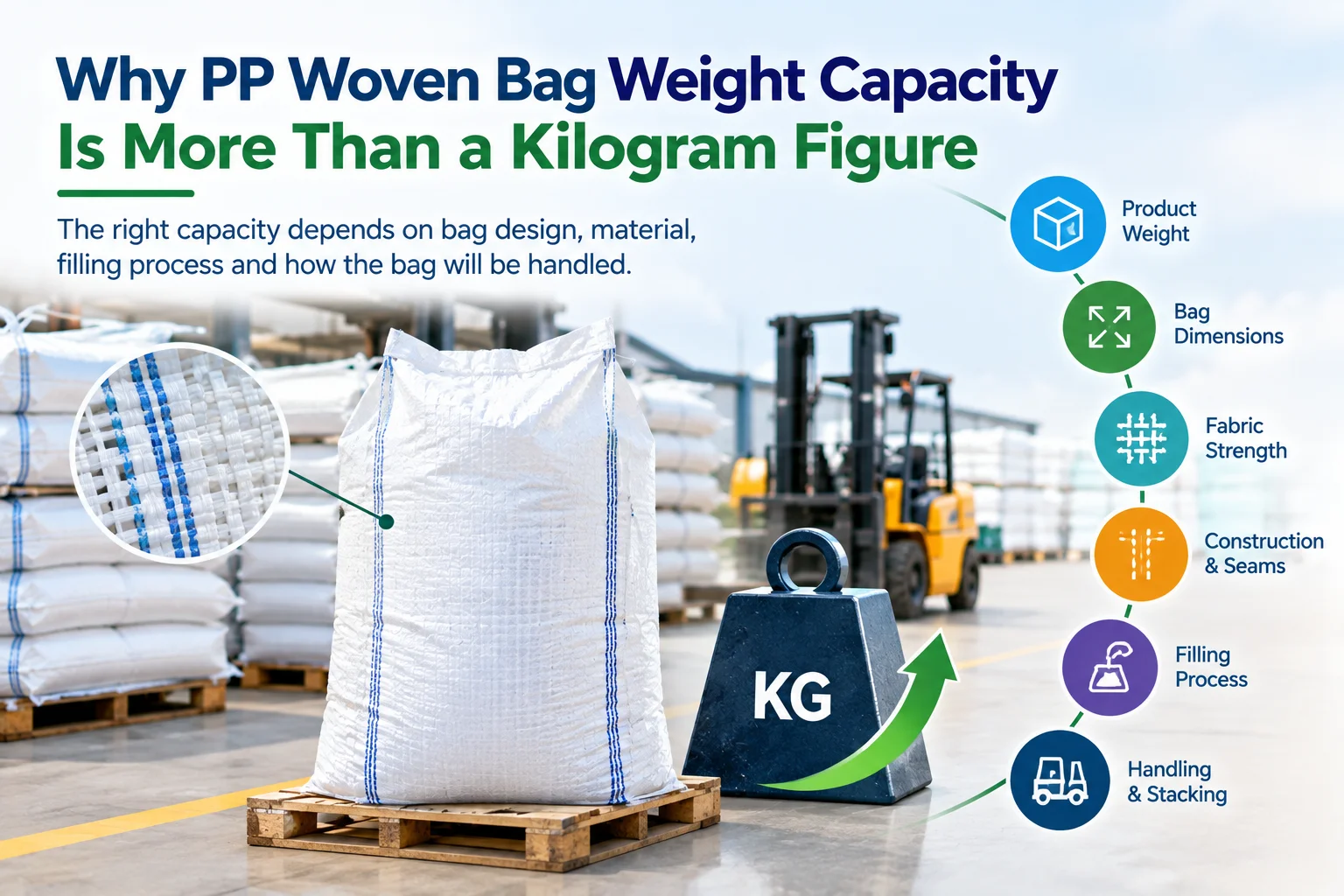
When buyers search for PP woven bag weight capacity, they often expect a simple answer such as 25 kg, 50 kg or 100 kg. In reality, the correct capacity must be connected to the bag design.
A useful specification considers the intended product weight, bag dimensions, fabric strength, construction, seams, filling process and expected handling. A bag designed for a 50 kg product therefore should not be selected merely because its physical volume appears large enough for 50 kg.
The product itself also matters. A 50 kg bag of a relatively bulky agricultural commodity and a 50 kg bag of a dense industrial material can behave differently during filling, lifting and stacking.
Oberon Polypack describes its PP woven bags as suitable for heavy and bulk materials including grains, fertilisers, sugar, cement, sand and animal feed, with customisation available for load requirements.
The Main Specifications That Determine PP Woven Bag Load Capacity
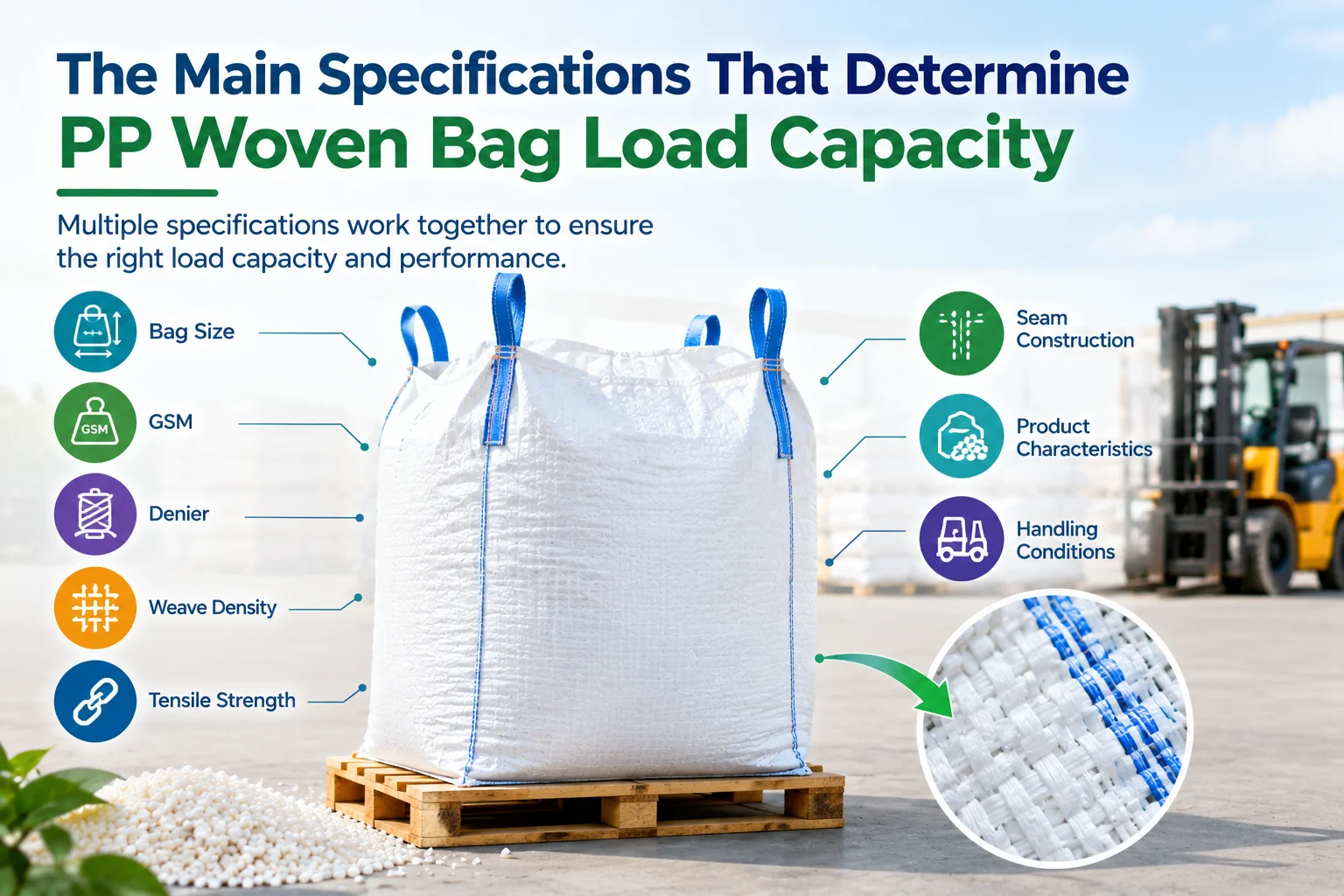
A strong bag is the result of several specifications working together. Increasing just one parameter does not automatically produce a proportional increase in carrying performance.
Before placing a bulk order, buyers should examine the complete bag specification.
- Bag size: Dimensions affect filling volume, fabric stress and the way the packed product settles inside the bag.
- GSM: Fabric weight can influence overall material construction, but higher GSM alone does not guarantee higher strength.
- Denier: Tape denier relates to tape thickness and contributes to the fabric's structural characteristics.
- Weave density: The number and arrangement of tapes influence fabric construction and mechanical performance.
- Tensile strength: This helps indicate how the fabric responds to pulling forces.
- Seam construction: A strong fabric can still have a weak finished bag if seams are poorly designed or manufactured.
- Product characteristics: Density, particle shape and filling behaviour influence how loads act on the bag.
- Handling conditions: Lifting, stacking, dropping and transportation can create additional stresses.
The important point is that PP woven bag specifications need to be considered as a package. A procurement team should avoid selecting a bag solely by GSM or advertised weight capacity.
PP Woven Bag Load Capacity vs Bag Dimensions
Dimensions have a surprisingly important role in PP Woven Bag Load Capacity. A wider or taller bag changes how the product distributes its weight and how the fabric is loaded during handling.
A bag that is too small may be difficult to fill efficiently. One that is excessively large for the product can allow the contents to shift, potentially changing how the bag behaves during stacking and transportation.
Bag proportions also matter for palletising. If bags are intended to be stacked, the dimensions should work with the pallet size, warehouse arrangement and transport configuration.
For this reason, specify the target product weight and approximate product volume together. The supplier can then assess whether the proposed bag dimensions are appropriate rather than working from weight alone.
How GSM Affects PP Woven Bag Weight Capacity
GSM, or grams per square metre, is one of the most commonly discussed specifications when selecting woven packaging.
However, PP woven bag GSM should not be treated as a direct load-capacity rating. A heavier fabric can indicate more material per square metre, but the final strength depends on the raw material, tape properties, weave construction and manufacturing consistency.
Oberon's published information states that its PP woven packaging can be customised in GSM and other specifications, while its technical content also explains that GSM and denier describe different characteristics of woven fabric.
The practical lesson is simple: use GSM as one part of the specification, not the entire specification.
Denier and PP Woven Bag Strength
Denier is another important specification when discussing PP woven bag strength. It relates to the thickness of the polypropylene tape used to form the woven structure.
A higher denier can contribute to a stronger fabric construction, but it does not mean that every high-denier bag will automatically outperform every lower-denier bag. Weave density, raw-material quality, tape strength and production consistency still matter.
This is why PP woven bag denier should be considered alongside GSM and the required product weight.
Oberon Polypack's published guidance specifically notes that GSM measures fabric weight while denier relates to tape thickness, and that both specifications work together with raw-material quality and weaving consistency to influence packaging performance.
GSM vs Denier: What Buyers Should Understand
| Specification | What it describes | Why it matters | What it does not tell you by itself |
|---|---|---|---|
| GSM | Fabric weight per square metre | Helps define fabric construction and material usage | Exact bag load capacity |
| Denier | Tape thickness | Helps define tape construction and strength characteristics | Finished-bag performance |
| Weave density | Tape arrangement | Influences fabric structure | Complete handling strength |
| Tensile strength | Resistance to pulling force | Useful for evaluating material performance | Total safe working capacity |
| Bag dimensions | Finished bag size | Influences volume and load distribution | Fabric strength |
| Seam construction | How panels are joined | Important for finished-bag integrity | Fabric quality |
This is why PP woven bag load capacity should always be specified using several technical parameters rather than one measurement.
PP Woven Bag Tensile Strength and Load Performance
PP woven bag tensile strength describes how the woven material responds to pulling forces. It is an important indicator when assessing fabric performance, but it should not be interpreted as the same thing as the bag's allowable product weight.
The finished bag has additional variables. Seams, handles if present, corners, stitching and the way the bag is lifted can all influence the forces experienced during handling.
Imagine a bag filled with 50 kg of product being lifted from one side. The force distribution is not identical to that of the same bag sitting undisturbed on a warehouse floor.
For that reason, a supplier should assess the finished bag construction rather than relying on fabric tensile data alone.
Understanding PP Woven Bag Burst Strength
PP woven bag burst strength is relevant when the packed product pushes outward against the fabric and seams. This can happen during filling, stacking or rough handling.
Burst performance becomes particularly important when packaging powders, granules or products that settle tightly inside the bag. The internal pressure can behave differently depending on the product's shape and density.
A bag with good tensile properties may still require careful consideration of seam construction and overall dimensions. In practical packaging design, the fabric and finished bag need to work together.
How Product Type Changes PP Woven Bag Load Capacity
The same bag specification may not be suitable for every bulk product. Product density, particle size, flow characteristics and shape can change the stresses placed on the bag.
For example, agricultural grains may settle differently from fertiliser granules. Cement and minerals can create high-density loads, while lighter agricultural materials may occupy more volume at the same weight.
This is why PP woven bags for bulk products should be designed around both weight and volume.
Oberon Polypack identifies agriculture, food, chemicals, construction and industrial applications among the industries using its PP woven bags.
Matching Heavy-Duty PP Woven Bags to the Application
Heavy duty PP woven bags are not defined simply by being thick or heavy. Their suitability comes from how the overall construction is matched to the application.
A demanding application may require higher fabric strength, appropriate dimensions, reinforced construction or a particular seam arrangement. It may also require lamination or another feature when additional protection against moisture or dust is needed.
For outdoor storage, UV stabilisation can also be relevant. Oberon Polypack states that UV-stabilised fabric is available for applications involving sunlight and outdoor exposure.
The right heavy-duty specification is therefore application-specific.
How Handling and Stacking Affect PP Woven Bag Load Capacity
A bag does not experience the same stress throughout its life.
During filling, the material expands against the fabric. During lifting, the load is transferred through the seams and fabric. During stacking, pressure is applied from bags above. During transportation, vibration, movement and occasional impact can add further stress.
This means PP woven bag carrying capacity should be considered in the context of the complete supply chain.
A bag intended to sit on a pallet in controlled warehouse conditions may have different requirements from one that will be manually loaded, stacked high and transported over rough roads.
Before ordering, tell the manufacturer how the bag will actually be handled. That information can be more useful than simply stating a target weight.
How to Specify a PP Woven Bag for a 25 kg, 50 kg or 100 kg Product
There is no universal GSM or denier value that can safely be assigned to every 25 kg, 50 kg or 100 kg bag. The correct specification depends on the product, dimensions, handling conditions and required safety margin.
Instead of saying, "We need a 50 kg PP bag," give the supplier a complete brief:
- Product: What are you packing?
- Target net weight: How much product goes into each bag?
- Product density: How much volume does that weight occupy?
- Bag dimensions: What size is required?
- Handling: Manual or mechanical?
- Stacking: How high will bags be stacked?
- Environment: Indoor, outdoor, humid or exposed to sunlight?
- Protection: Is lamination or lining required?
This gives the manufacturer enough information to recommend the appropriate PP woven packaging bag capacity.
PP Woven Bag Weight Limit: Why Buyers Should Be Careful
The phrase PP woven bag weight limit can be misleading if it is treated as a universal specification.
A bag's capacity should be established for its intended construction and use. Buyers should not assume that a bag designed for one product or application can safely carry the same weight in another environment.
For bulk orders, request the relevant technical specification and clarify how the stated capacity has been determined. If the application involves demanding lifting, stacking or transportation conditions, explain those conditions before approving production.
This approach is much safer than relying on a generic "heavy-duty" label.
How to Choose a PP Woven Bag Supplier
The right PP woven bag supplier should be able to discuss the relationship between product weight and bag construction.
Ask about available GSM, denier, dimensions, weave, lamination, printing and construction options. For demanding applications, discuss tensile performance, seam construction and expected handling conditions.
Oberon Polypack states that it offers customised PP woven bags for different load, moisture-resistance and printing requirements and supplies packaging for agriculture, chemicals, food, construction and industrial applications. Its published export information also describes a process covering specification discussion, sample approval, manufacturing and quality inspection.
That type of specification-led process is useful when the bag needs to perform consistently across large production runs.
Common Mistakes When Selecting PP Woven Bag Load Capacity
One common mistake is selecting a bag based only on its physical volume. A bag can be large enough to contain a product without being appropriately engineered for its weight and handling conditions.
Another is choosing the highest GSM available and assuming the problem is solved. GSM matters, but so do denier, weave density, tape quality, seams and manufacturing consistency.
A third mistake is ignoring transportation. A bag may survive filling and warehouse storage but experience additional stress during loading, unloading and long-distance shipment.
Finally, buyers sometimes change the product weight or dimensions after approving a sample. Even a relatively small specification change can affect the suitability of the finished packaging, so the supplier should be informed before production.
PP Woven Bag Load Capacity Checklist for Bulk Buyers
Before approving a large order, make sure the supplier understands the complete requirement:
| Buyer requirement | What to confirm |
|---|---|
| Product | Exact material being packed |
| Net weight | Target weight per bag |
| Product density | Approximate volume at target weight |
| Bag dimensions | Width, length and gusset if applicable |
| GSM | Required fabric weight |
| Denier | Tape specification |
| Construction | Weave and fabric design |
| Strength | Relevant tensile and finished-bag requirements |
| Seams | Stitching and seam construction |
| Environment | Indoor/outdoor and moisture exposure |
| UV | Requirement for sunlight exposure |
| Lamination | Required or not required |
| Quantity | Trial, regular or bulk production |
A detailed PP woven bag specifications sheet helps reduce misunderstandings between procurement teams and manufacturers.
Conclusion
Choosing the right PP Woven Bag Load Capacity is really about matching the entire bag construction to the product and the supply chain. Product weight is only the starting point. GSM, denier, weave density, tensile performance, dimensions, seams, product density, stacking and transportation conditions all influence whether a bag is appropriate for the job. A properly defined specification helps buyers avoid both under-engineered packaging and unnecessary material costs.
If you need PP Woven Bag Load Capacity matched to a specific product weight, product type or bulk-packaging application, work with a manufacturer that can evaluate the complete requirement rather than quoting a generic capacity. Oberon Polypack supplies customised PP woven bags for agricultural, food, chemical, construction and industrial applications. contact Oberon Polypack to discuss your required specifications and bulk-order requirements.
FAQs
1. What is PP woven bag load capacity?
PP woven bag load capacity is the amount of product the finished bag is designed to contain and handle under its intended conditions. It depends on the bag's dimensions, fabric construction, strength, seams, product characteristics and handling environment rather than one specification alone.
2. How much weight can a PP woven bag carry?
There is no single weight that applies to every PP woven bag. Bags can be manufactured for different product weights and applications. The appropriate capacity should be established from the product, bag size, construction and expected handling conditions.
3. Does higher GSM mean a stronger PP woven bag?
Not automatically. Higher GSM means more fabric weight per square metre, but finished-bag strength also depends on denier, tape quality, weave density, manufacturing consistency and seams. GSM should therefore be considered as part of the complete specification.
4. What is the difference between GSM and denier in PP woven bags?
GSM measures the weight of the woven fabric per square metre, while denier relates to the thickness of the polypropylene tape. Both can influence the final fabric construction, but neither independently determines the finished bag's load capacity.
5. Are PP woven bags suitable for heavy bulk products?
Yes, appropriately specified PP woven bags are widely used for bulk products including grains, fertilisers, cement, sand, minerals and animal feed. The bag should be designed according to the product weight, dimensions and handling requirements.
6. How do I choose the right PP woven bag for my product?
Start with the product, target net weight, density, dimensions and handling conditions. Then discuss GSM, denier, fabric construction, tensile performance, seams, lamination and any UV or moisture requirements with the manufacturer. A complete specification is more useful than choosing a bag based on weight alone.