Packaging has become one of the most important factors influencing the success of a rice brand in today's global marketplace. Whether rice is sold through supermarkets, wholesalers, distributors, or export channels, the packaging does far more than simply hold the product. It protects grain quality, preserves freshness, communicates your brand, complies with food safety regulations, and creates the first impression that influences purchasing decisions.
As international trade continues to expand, buyers are placing greater emphasis on packaging quality. Exporters now require solutions that can withstand long-distance transportation, varying climates, warehouse storage, and repeated handling without compromising the product inside. At the same time, attractive packaging has become a powerful marketing tool, helping brands stand out on increasingly competitive retail shelves. If you're interested in understanding the material behind these packaging solutions, our guide on PP Woven Fabric explains how woven polypropylene provides the strength and durability needed for modern food packaging.
Choosing the right Rice Packaging Bags is therefore a strategic business decision rather than simply selecting a bag. Factors such as material type, GSM, bag size, printing technology, moisture resistance, and food-grade compliance all influence product protection, logistics efficiency, and customer satisfaction. Understanding these specifications allows importers, exporters, packaging buyers, and manufacturers to make informed decisions that reduce costs while improving product quality.
This comprehensive 2026 buying guide explains the different types of rice bags available, compares packaging materials, explores standard bag sizes, reviews printing options, and shares practical advice for selecting packaging that performs reliably in domestic and international markets.
What Are Rice Packaging Bags?
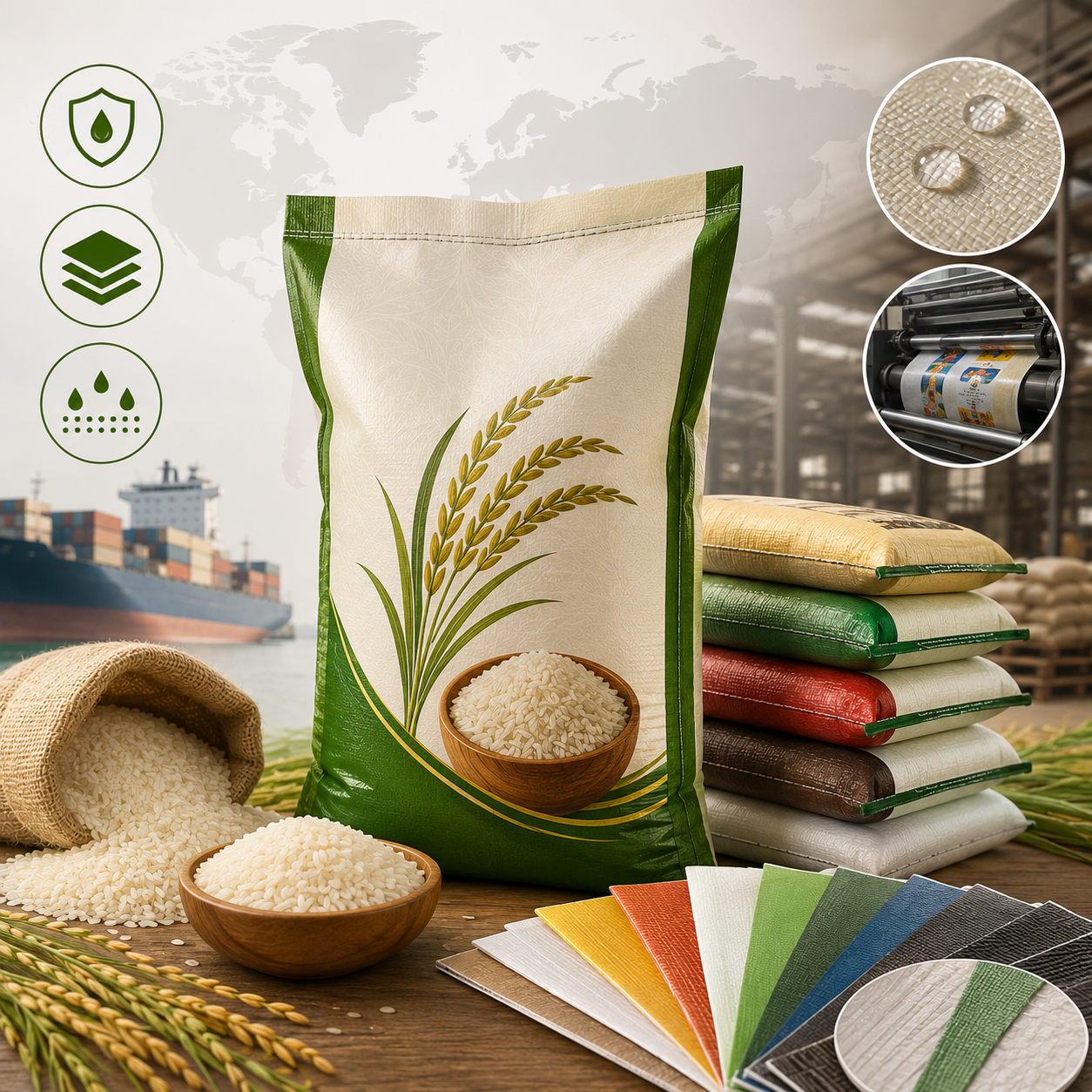
Rice Packaging Bags are specialised packaging solutions designed to store, protect, transport, and market rice throughout the supply chain. Unlike ordinary plastic bags, they are engineered to withstand heavy loads, resist moisture, maintain product hygiene, and preserve grain quality during storage and international shipping.
Modern rice bags are commonly manufactured from polypropylene woven sacks, which combine lightweight construction with exceptional tensile strength. Depending on the application, the fabric may also be laminated with BOPP film to improve moisture resistance, print quality, and retail presentation.
Packaging manufacturers produce rice bags in a wide variety of sizes, colours, fabric weights, and finishes. Some are intended for bulk wholesale distribution, while others are designed for premium retail shelves where attractive branding plays a significant role in consumer purchasing decisions.
Today's Rice Packaging Bags often incorporate advanced features such as laminated surfaces, food-grade inner liners, anti-slip coatings, UV stabilisation, easy-open designs, and high-definition printing. These enhancements improve product protection while helping businesses strengthen their market presence.
Understanding Modern Rice Packaging
Modern rice packaging has evolved significantly over the past decade. Earlier packaging focused primarily on storage and transportation, whereas today's packaging solutions must simultaneously protect the product, communicate brand identity, comply with food safety regulations, and support efficient logistics.
For example, a premium basmati rice brand exported to Europe may require high-resolution printing, multilingual labels, moisture-resistant lamination, and food-grade materials. In contrast, bulk rice supplied to wholesalers may prioritise durability, stackability, and cost efficiency over decorative packaging.
Because every market has different expectations, manufacturers offer extensive customisation options that allow businesses to select packaging specifications matching their distribution channels and customer requirements.
Why Choosing the Right Rice Packaging Bags Matters
Selecting the right packaging influences every stage of the supply chain, from production and warehousing to transportation, retail display, and customer satisfaction. Poor-quality packaging increases the risk of torn bags, product contamination, moisture damage, and transportation losses, all of which can result in unnecessary costs and damage to brand reputation.
High-quality rice bags help preserve grain quality by protecting against humidity, dust, pests, and physical damage. This is particularly important for premium rice varieties where appearance, aroma, and freshness directly influence product value.
Packaging also affects operational efficiency. Uniform bag dimensions improve pallet stability, maximise warehouse utilisation, and simplify container loading during exports. Strong woven construction reduces product losses caused by bag failures while improving handling efficiency throughout logistics operations.
From a marketing perspective, packaging serves as a silent salesperson. A professionally designed BOPP rice bag with vibrant printing immediately communicates quality, helping products attract attention on crowded supermarket shelves. Even before customers examine the rice itself, packaging shapes their perception of the brand.
As sustainability becomes increasingly important, many businesses also prefer recyclable food grade PP woven bags that combine durability with responsible material usage. Long-lasting packaging reduces waste throughout the supply chain while supporting broader environmental objectives.
Ultimately, investing in well-designed Rice Packaging Bags protects both the product and the brand. Businesses that choose appropriate materials, construction, and printing technologies typically experience fewer packaging failures, stronger customer confidence, and better long-term profitability.
Why Exporters Need Different Packaging Than Domestic Suppliers
Export packaging faces significantly greater challenges than packaging intended for local distribution. Rice shipped internationally may spend several weeks inside shipping containers while experiencing changing temperatures, humidity levels, multiple handling operations, and extended warehouse storage.
For this reason, export rice packaging bags generally require stronger woven construction, enhanced seam strength, improved moisture resistance, and higher-quality printing that remains intact throughout transportation. Many exporters also choose laminated packaging because it protects both the product and the printed graphics during long-distance shipping.
International buyers frequently specify additional packaging requirements, including food-contact compliance, multilingual product information, traceability markings, country-of-origin labels, batch numbers, and barcode systems. Selecting packaging that satisfies these expectations improves customs clearance, distributor confidence, and overall customer satisfaction.
Understanding these export requirements helps businesses choose packaging that not only protects the rice but also supports successful international trade.
Best Materials for Rice Packaging Bags
Selecting the right material is one of the most important decisions when choosing Rice Packaging Bags. The packaging material determines how well the rice is protected against moisture, punctures, rough handling, and long-distance transportation. It also influences print quality, production costs, shelf appeal, and overall product performance.
Modern rice packaging primarily relies on woven polypropylene because it offers an excellent combination of strength, flexibility, lightweight construction, and cost efficiency. However, different packaging formats are available depending on whether the product is intended for wholesale distribution, premium retail shelves, or international export.
Understanding the advantages of each material helps buyers choose packaging that matches their product, target market, and budget.
PP Woven Rice Bags: The Industry Standard
The PP woven rice bag is one of the most widely used packaging solutions in the global rice industry. It is manufactured from woven polypropylene tapes that create a strong yet lightweight fabric capable of carrying substantial loads without tearing.
Its popularity comes from its exceptional balance of durability and affordability. The woven construction distributes weight evenly across the bag, allowing it to withstand stacking, transportation, and repeated handling during warehouse operations.
Because polypropylene has excellent resistance to moisture and abrasion, woven rice sacks maintain their structural integrity even during extended storage or overseas shipping. Manufacturers also produce these bags in various widths, GSM ranges, colours, and strengths to meet different packaging requirements.
From small retail packs to industrial bulk packaging, PP woven bags remain one of the most reliable packaging materials available today.
Typical Applications
- Retail rice packaging
- Wholesale rice distribution
- Agricultural products
- Food grains
- Export packaging
BOPP Rice Bags: Premium Packaging for Modern Brands
For brands competing in supermarkets and international retail markets, a BOPP rice bag offers a significant advantage over conventional woven bags.
A BOPP laminated bag combines woven polypropylene fabric with a biaxially oriented polypropylene (BOPP) film laminated onto the outer surface. This construction creates a smooth finish capable of supporting high-definition printing with vibrant colours and photographic-quality graphics.
Premium rice brands use this packaging to communicate product quality before consumers even pick up the bag. Attractive packaging enhances shelf visibility while strengthening brand recognition and customer trust.
In addition to aesthetics, lamination provides improved resistance to moisture, dirt, scratches, and abrasion. These protective properties help preserve both the product and the printed design throughout transportation and storage.
Many exporters also prefer laminated packaging because it maintains its professional appearance even after long shipping journeys.
Food Grade PP Woven Bags for Safe Packaging
Food safety is a critical consideration when selecting packaging for rice. Food grade PP woven bags are manufactured using virgin polypropylene resin under controlled production conditions to minimise contamination risks and maintain product quality.
Unlike general-purpose woven bags, food-grade packaging follows stricter quality standards regarding raw materials, cleanliness, and manufacturing processes. Many products also incorporate food-safe inner liners that provide additional protection against dust, moisture, and external contaminants.
These bags are widely used for rice, flour, sugar, pulses, spices, and other food products that require hygienic packaging throughout the supply chain.
For exporters, food-grade packaging also helps support compliance with customer requirements and food-contact regulations in international markets.
BOPP Laminated Bags vs Standard PP Woven Bags
Although both packaging types are manufactured using woven polypropylene fabric, they serve different business objectives. Choosing between them depends on your target customers, branding strategy, and transportation requirements.
| Feature | PP Woven Rice Bag | BOPP Laminated Bag |
|---|---|---|
| Structure | Woven polypropylene | Woven polypropylene + BOPP film |
| Printing Quality | Standard flexographic printing | High-definition rotogravure printing |
| Surface Finish | Textured woven surface | Smooth laminated surface |
| Moisture Protection | Good | Excellent |
| Shelf Appearance | Functional | Premium |
| Brand Visibility | Moderate | Excellent |
| Export Suitability | Excellent | Excellent, especially for retail exports |
| Typical Applications | Bulk packaging, wholesale | Premium retail packaging |
Both materials deliver excellent mechanical strength. However, businesses targeting premium retail shelves generally benefit from the superior print quality and enhanced product presentation offered by laminated packaging.
Why Polypropylene Is the Preferred Packaging Material
Polypropylene has become the global standard for rice packaging because it combines multiple performance advantages in a single material.
Unlike paper packaging, woven polypropylene offers higher tear resistance and better moisture protection. Compared with conventional plastic films, its woven construction provides significantly greater load-bearing capacity while remaining lightweight and economical.
Another important advantage is manufacturing flexibility. Polypropylene can be woven into fabrics of different GSM values, laminated, printed, coloured, UV stabilised, or customised according to customer requirements. This versatility enables manufacturers to produce packaging suitable for both low-cost wholesale distribution and premium retail branding.
Many businesses also appreciate polypropylene because it is recyclable in markets where appropriate recycling infrastructure exists, supporting broader sustainability initiatives.
How Material Selection Affects Packaging Costs
Material choice influences not only packaging performance but also the total cost of ownership. While standard woven bags generally have lower production costs, premium laminated bags often deliver greater value through improved product presentation, reduced damage, and stronger brand recognition.
Several factors affect packaging costs:
- Raw material quality (virgin vs. recycled polypropylene)
- Fabric GSM and denier
- Lamination requirements
- Printing technology and number of colours
- Bag dimensions and load capacity
- Additional features such as liners, handles, or easy-open designs
Rather than selecting packaging based solely on price, businesses should evaluate the overall value provided throughout storage, transportation, retail display, and customer use.
Choosing the Best Material for Your Business
The most suitable material depends on your product, sales channel, and business objectives.
If your focus is wholesale distribution, a durable PP woven rice bag often provides excellent value through reliable strength and economical production. If you are building a premium retail brand, a BOPP laminated bag offers superior shelf appeal and stronger consumer recognition.
For food exports, combining food-grade woven polypropylene with appropriate lamination and printing creates packaging that protects the product while meeting international market expectations.
If you'd like to understand how these materials are produced, our guide on PP Woven Fabric Manufacturing explains the complete manufacturing process from polypropylene granules to finished woven fabric.
Standard Rice Bag Sizes for Domestic and Export Markets
Choosing the correct bag size is just as important as selecting the right material. The size of Rice Packaging Bags affects storage efficiency, transportation costs, pallet utilisation, consumer convenience, and overall packaging performance. A well-selected bag size reduces handling costs while ensuring the product reaches customers in excellent condition.
Rice is sold through multiple distribution channels, including supermarkets, wholesalers, institutional buyers, restaurants, government procurement programmes, and export markets. Each channel has different packaging requirements, which is why manufacturers produce woven rice sacks in a wide range of standard capacities.
Understanding these common sizes helps buyers select packaging that matches both customer expectations and operational requirements.
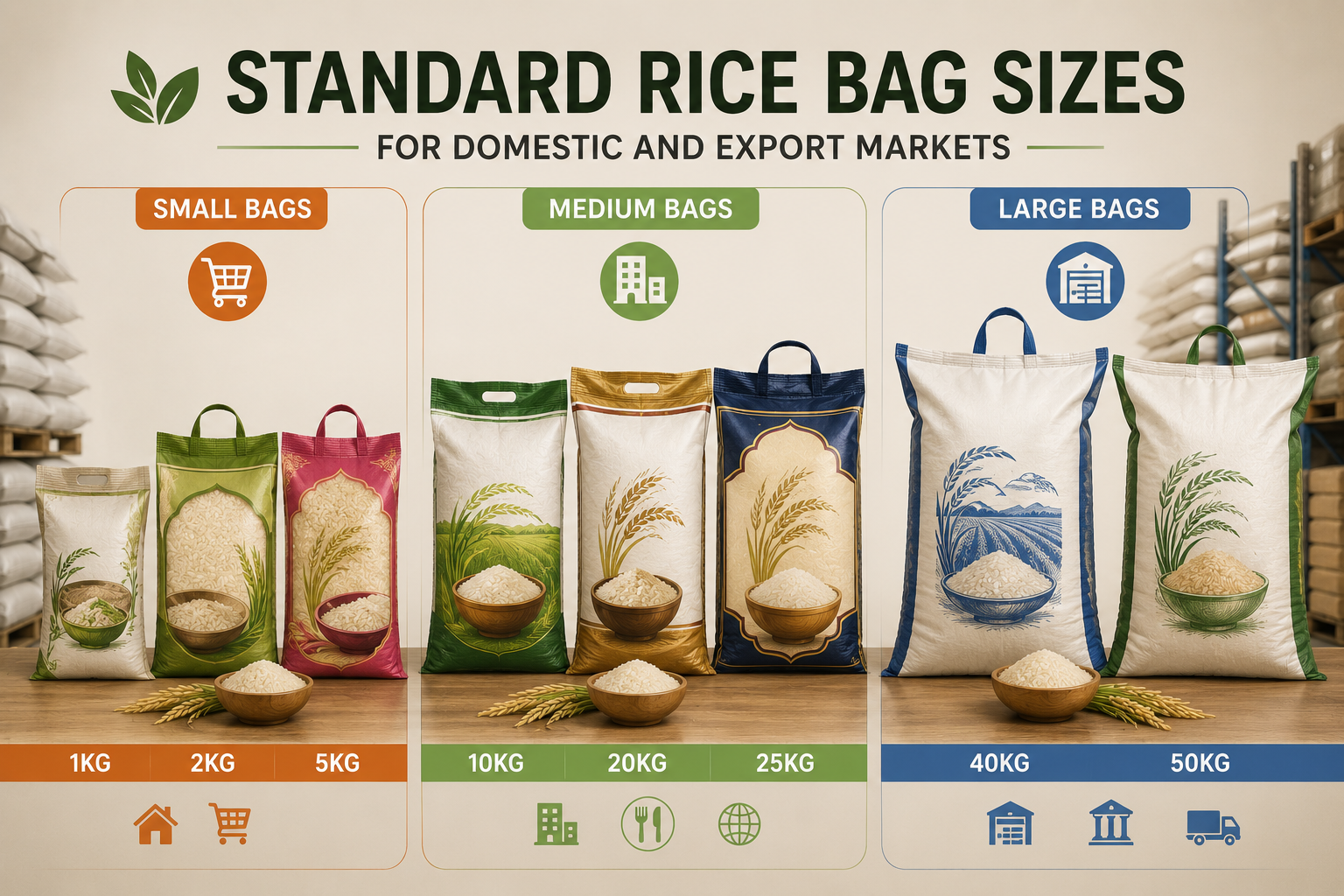
Small Rice Bags (1 kg, 2 kg & 5 kg)
Small-capacity rice bags are designed primarily for retail consumers. They are commonly found in supermarkets, grocery stores, convenience stores, and e-commerce platforms where buyers prefer convenient pack sizes for household use.
Premium rice varieties such as basmati, jasmine, sushi rice, and organic rice are frequently packaged in this range because smaller packs allow brands to showcase attractive packaging while maintaining freshness after purchase.
Many manufacturers prefer laminated packaging for these sizes because it supports premium printing and helps products stand out on retail shelves. Easy-carry designs, transparent windows, and resealable closures are also becoming increasingly popular in modern retail packaging.
Besides enhancing presentation, smaller bags simplify storage and handling for consumers, making them an excellent choice for urban households.
Medium Rice Bags (10 kg, 20 kg & 25 kg)
Medium-capacity packaging serves both commercial users and larger families. Hotels, restaurants, catering businesses, food processors, and wholesale retailers frequently purchase rice in this range because it provides a practical balance between quantity and ease of handling.
Among all medium-sized packages, the 25 kg BOPP rice packaging bag is one of the most popular choices for international trade. It combines the strength of woven polypropylene with high-quality BOPP lamination, providing excellent product protection together with premium shelf presentation.
This size is widely used by exporters supplying distributors, supermarkets, and food service businesses because it optimises transportation efficiency while remaining manageable during loading and unloading.
The larger printable surface also allows manufacturers to include multilingual product information, nutritional details, certification logos, cooking instructions, QR codes, and traceability information required in many international markets.
Large Rice Bags (40 kg & 50 kg)
Large-capacity rice bags are primarily intended for wholesale distribution, government procurement programmes, institutional kitchens, bulk agricultural trading, and industrial food processing.
The 40 kg PP woven rice packaging bag is particularly valued for its high load-bearing capacity and excellent durability. Manufactured from heavy-duty woven polypropylene, it withstands repeated lifting, stacking, and transportation without compromising structural integrity.
Many international buyers also continue to specify 50 kg woven rice sacks because they maximise shipping efficiency by reducing the number of individual packages required per shipment. Although larger bags require stronger fabric specifications, they help reduce packaging material per kilogram of rice transported.
For these applications, manufacturers often use higher GSM woven fabric together with reinforced stitching and optional inner liners to provide additional protection against moisture and contamination.
Choosing the Right Bag Size for Your Market
Selecting the appropriate bag size involves understanding your target customers rather than simply choosing the largest or smallest available option. Consumer preferences, logistics requirements, and distribution channels all influence which packaging size delivers the greatest value.
When evaluating bag sizes, buyers should consider:
Target customer: Retail consumers typically prefer smaller packs, while wholesalers and institutional buyers require larger capacities.
Transportation efficiency: Larger bags reduce the total number of packages, whereas smaller bags improve retail convenience.
Warehouse storage: Uniform bag dimensions simplify palletisation and maximise storage space.
Handling requirements: Medium-sized bags are often easier to load and unload without specialised equipment.
Brand positioning: Premium retail products generally benefit from attractive smaller packaging with high-quality printing.
Market regulations: Some countries specify preferred packaging capacities for imported food products.
Selecting the correct bag size helps improve supply chain efficiency while enhancing customer satisfaction and reducing unnecessary logistics costs.
Packaging Dimensions and Pallet Optimisation
Bag capacity is only one aspect of packaging design. The physical dimensions of the bag also affect pallet stability, warehouse utilisation, and shipping efficiency.
Manufacturers optimise bag width, length, and gusset dimensions to ensure efficient stacking while minimising unused space inside shipping containers. Well-designed bags maintain their shape during filling, allowing pallets to remain stable throughout transportation.
For exporters, proper pallet optimisation can significantly reduce freight costs because containers are utilised more efficiently. Even small improvements in packaging dimensions can increase the number of bags transported per shipment without exceeding weight limitations.
Many packaging manufacturers work closely with exporters to customise bag dimensions according to specific pallet sizes and destination-country logistics requirements.
Export Packaging Considerations
International shipments expose rice packaging to significantly harsher conditions than domestic distribution. Products may remain inside shipping containers for several weeks while experiencing fluctuating temperatures, humidity, repeated handling, and extended warehouse storage.
For this reason, export rice packaging bags are generally manufactured with stronger woven fabrics, reinforced stitching, moisture-resistant construction, and durable printing that remains legible throughout transportation.
Export packaging should also include accurate product identification, country-of-origin information, batch numbers, production dates, barcode systems, and multilingual labels where required. These features improve customs clearance, inventory management, and traceability while enhancing customer confidence.
Businesses exporting premium rice often choose customised packaging that combines excellent mechanical strength with attractive branding, helping products compete successfully in international retail markets.
If you're comparing packaging specifications for different woven materials, our guide on PP Woven Sack Fabric Specifications explains how GSM, denier, and tensile strength influence packaging performance.
Printing Options for Rice Packaging Bags
Packaging is often the first interaction a customer has with your product. Before they judge the quality of the rice, they notice the design, colours, finish, and information displayed on the bag. This makes printing an essential part of Rice Packaging Bags, not just for branding but also for product identification, regulatory compliance, and consumer trust.
Modern printing technologies enable manufacturers to produce packaging with vibrant graphics, sharp text, and durable finishes that remain attractive throughout transportation and retail display. Whether your business supplies local supermarkets or exports premium rice internationally, choosing the right printing method can significantly improve your brand's visibility and market appeal.
Flexographic Printing for Cost-Effective Packaging
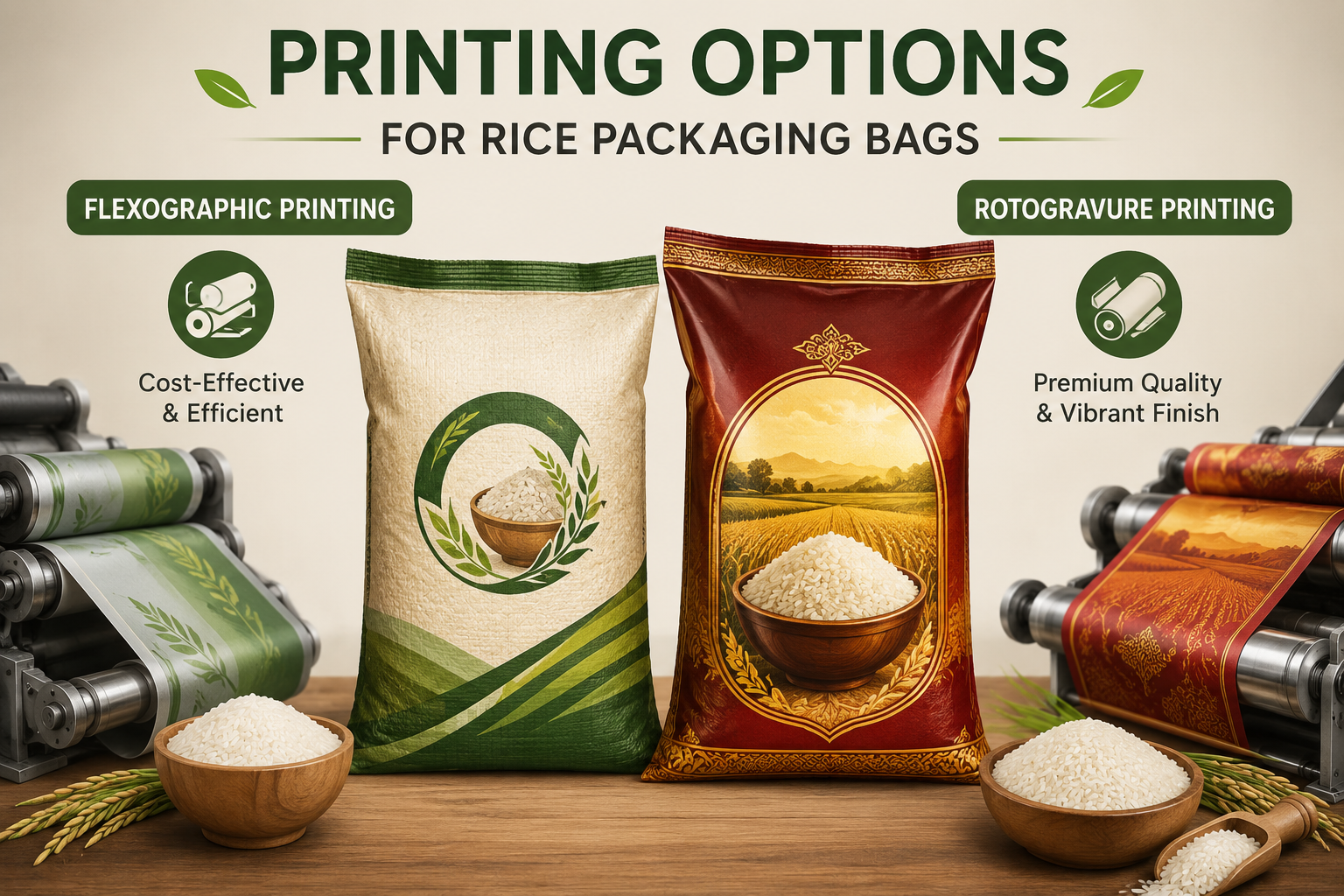
Flexographic printing remains one of the most widely used techniques for woven packaging because it offers an excellent balance between quality and production efficiency.
This method is particularly suitable for packaging that requires simple branding, company logos, product names, and basic product information. Manufacturers supplying wholesale markets or commodity rice often prefer flexographic printing because it allows high-volume production at competitive costs.
Modern flexographic equipment produces clear, durable prints that perform well during transportation and warehouse storage. While it cannot reproduce photographic images with the same precision as rotogravure printing, it remains an economical solution for many industrial packaging applications.
Rotogravure Printing for Premium Retail Packaging
When premium branding is the priority, rotogravure printing is widely considered the industry standard. This process is commonly used for printed BOPP bags because it produces exceptional image quality with vibrant colours, smooth gradients, and sharp text.
Premium rice brands frequently use rotogravure printing to display product photography, cooking suggestions, nutritional information, certification logos, QR codes, and multilingual packaging. The superior print resolution helps products stand out in supermarkets where packaging plays a major role in purchasing decisions.
Another advantage of rotogravure printing is colour consistency across large production runs. Exporters serving multiple countries benefit from maintaining identical packaging regardless of production volume.
Benefits of Custom Rice Packaging Bags
Generic packaging protects the product, but custom rice packaging bags help build a memorable brand. Customisation allows businesses to communicate product quality while meeting customer and regulatory requirements in different markets.
Modern rice bags can include:
- Brand logos and product photography
- Nutritional information
- Cooking instructions
- Country of origin
- Batch numbers and traceability codes
- QR codes
- Certification logos
- Multilingual product information
Well-designed packaging improves shelf visibility, increases consumer confidence, and helps establish long-term brand recognition. For exporters entering new markets, customised packaging also makes it easier to comply with local labelling regulations without changing the product itself.
Export Packaging Requirements
International buyers expect packaging that combines durability with complete product information. In addition to attractive printing, export packaging must often satisfy food-contact requirements, import regulations, and destination-country labelling standards.
Typical export packaging includes product name, net weight, ingredients (where applicable), nutritional values, manufacturing details, country of origin, storage instructions, barcode systems, and batch traceability.
Many countries also require multilingual labelling, particularly when products are distributed across multiple regions. Durable printing ensures this information remains legible even after long-distance transportation and extended warehouse storage.
Export-quality printing therefore contributes not only to branding but also to regulatory compliance and supply chain efficiency.
How to Choose a Rice Bag Manufacturer
Selecting the right rice bag manufacturer is essential for achieving consistent packaging quality. Beyond competitive pricing, businesses should evaluate the supplier's manufacturing capabilities, quality assurance systems, production capacity, and experience serving international markets.
When assessing a manufacturer, consider:
- Production capacity and delivery reliability
- Experience with export packaging
- Availability of food-grade materials
- Printing and customisation capabilities
- Quality control procedures
- Ability to manufacture multiple bag sizes and specifications
- Technical support for packaging selection
Manufacturers with modern equipment and well-established quality systems are generally better positioned to deliver consistent products that meet international customer expectations.
Companies such as Oberon Polypack specialise in manufacturing high-quality woven packaging solutions designed for food, agriculture, industrial products, and export markets. Their ability to customise fabric specifications, bag dimensions, and printing options enables businesses to create packaging tailored to specific applications.
Packaging Cost Factors
Packaging cost is influenced by much more than the price of raw materials. Businesses should evaluate total value rather than focusing only on unit cost because high-quality packaging often reduces product losses, transportation damage, and customer complaints.
Several factors influence the overall cost of Rice Packaging Bags:
- Fabric GSM and strength
- Virgin versus recycled polypropylene
- Lamination requirements
- Number of printing colours
- Bag dimensions
- Food-grade inner liners
- Stitching quality
- Order quantity
- Custom branding requirements
Although premium packaging may involve a higher initial investment, it often delivers better long-term value through improved product protection, stronger branding, and reduced operational losses.
BOPP Rice Bags vs PP Woven Rice Bags
Choosing between a BOPP rice bag and a PP woven rice bag depends on your product positioning, distribution strategy, and branding objectives.
| Feature | PP Woven Rice Bag | BOPP Rice Bag |
|---|---|---|
| Construction | Woven polypropylene | Woven polypropylene with BOPP lamination |
| Print Quality | Standard | Premium photographic quality |
| Surface Finish | Textured | Smooth glossy or matte finish |
| Moisture Resistance | Good | Excellent |
| Shelf Appeal | Functional | Premium |
| Branding Potential | Moderate | Excellent |
| Export Suitability | Very Good | Excellent |
| Typical Use | Wholesale & bulk packaging | Premium retail packaging |
Both packaging formats provide excellent strength and durability. However, businesses targeting supermarkets, international retailers, or premium consumer markets often achieve better brand recognition and higher perceived value with laminated BOPP packaging.
Future Trends in Rice Packaging
Packaging technology continues to evolve as consumer expectations and global trade requirements change. Modern rice packaging is becoming lighter, stronger, and more sustainable without compromising durability.
Emerging trends include recyclable woven materials, improved moisture barriers, digital traceability through QR codes, smart packaging for supply chain monitoring, and premium matte or metallic finishes for retail branding.
Many manufacturers are also investing in energy-efficient production technologies and advanced printing systems that reduce waste while improving packaging quality.
Businesses adopting these innovations are better positioned to meet future market expectations while strengthening their competitive advantage.
If you'd like to understand the manufacturing process behind woven packaging materials, our guide on PP Woven Fabric Manufacturing explains how polypropylene granules are transformed into high-strength woven fabric used in modern rice packaging. (Internal Link)
Rice Packaging Bags Buying Checklist
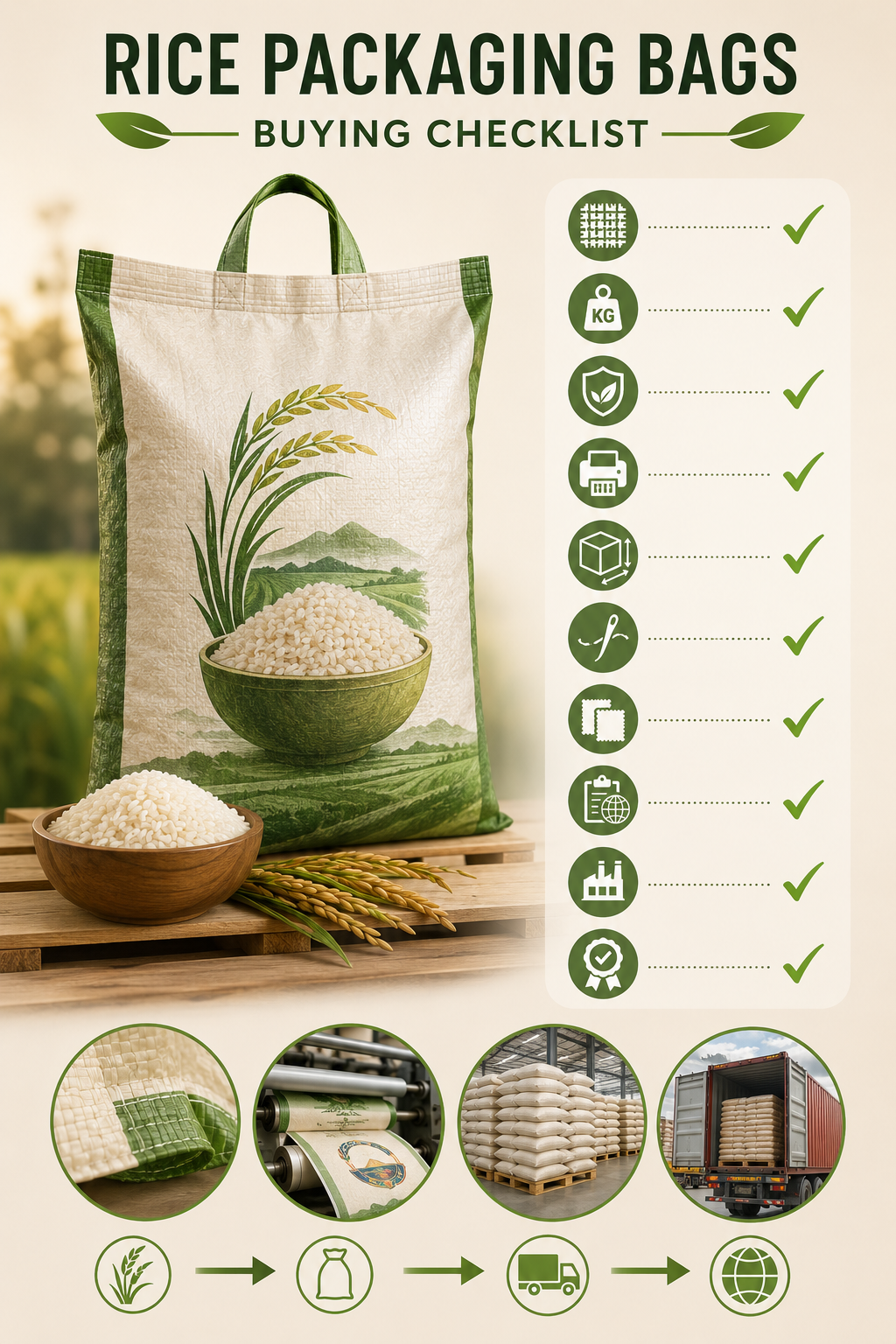
Choosing the right Rice Packaging Bags involves more than selecting a size or comparing prices. The ideal packaging should protect the product, support efficient logistics, strengthen your brand, and comply with the requirements of your target market. A structured evaluation process helps businesses avoid costly mistakes and invest in packaging that delivers long-term value.
Before placing a production order, review these important considerations:
- Select the appropriate material based on your product and distribution channel.
- Confirm the required GSM and load-bearing capacity.
- Choose food-grade materials for food packaging applications.
- Verify print quality and branding capabilities.
- Ensure bag dimensions match your pallet and container requirements.
- Check stitching quality and seam strength.
- Request production samples before approving bulk manufacturing.
- Review export documentation, labelling, and traceability requirements.
- Confirm production capacity and delivery timelines.
- Evaluate the supplier's quality assurance process and export experience.
Following this checklist helps minimise packaging failures while ensuring your products reach customers in excellent condition.
Common Mistakes to Avoid When Buying Rice Packaging Bags
Many businesses unintentionally increase packaging costs or reduce product quality by focusing on only one factor, such as price. Effective packaging requires balancing strength, appearance, durability, compliance, and logistics performance.
One common mistake is selecting packaging based solely on cost. Lower-priced bags may use lighter fabric, inconsistent weaving, or lower-quality raw materials, increasing the likelihood of tearing during transportation. The resulting product losses often outweigh the initial savings.
Another mistake is choosing the wrong bag size for the intended market. Oversized bags can create handling difficulties for retailers and consumers, while undersized packaging increases packaging costs per kilogram of rice.
Some buyers also overlook food safety requirements. Export markets frequently require food-grade materials, proper labelling, and traceability information. Packaging that fails to meet these expectations can lead to shipment delays or rejected consignments.
Poor printing quality is another issue. Packaging serves as a marketing tool, and faded graphics or unclear product information can reduce consumer confidence even when the rice itself is of excellent quality.
Finally, businesses should avoid selecting suppliers without evaluating manufacturing capability, quality control systems, and export experience. A dependable supplier consistently delivers packaging that meets agreed specifications across every production batch.
Sustainability and the Future of Rice Packaging
Sustainability has become an important consideration for both packaging manufacturers and global buyers. Governments, retailers, and consumers increasingly expect packaging solutions that minimise environmental impact while maintaining high product performance.
One of the advantages of woven polypropylene packaging is its durability. Strong bags often remain in service longer, reducing material consumption by lowering replacement frequency. In many regions, polypropylene is also recyclable where suitable collection and recycling infrastructure exists.
Manufacturers continue to improve production efficiency through energy-efficient machinery, reduced material waste, and optimised manufacturing processes. Advances in woven fabric technology also allow lighter fabrics to achieve comparable strength, reducing overall raw material usage without compromising packaging performance.
Another emerging trend is the integration of smart packaging features such as QR codes for traceability, authenticity verification, and consumer engagement. These technologies improve transparency throughout the supply chain while supporting digital inventory management.
As sustainability expectations continue to evolve, businesses investing in durable, recyclable, and efficiently manufactured Rice Packaging Bags are better positioned to meet future regulatory requirements and changing customer preferences.
Global Food Safety and Export Standards
International rice trade requires packaging that meets recognised food safety and quality expectations. While regulations vary between countries, buyers generally expect packaging materials to be suitable for food contact, manufactured under controlled conditions, and capable of protecting product quality throughout transportation and storage.
Exporters should ensure packaging includes accurate product identification, country of origin, production details, batch numbers, storage instructions, and any certification marks required by destination markets. Clear labelling improves traceability while supporting customs clearance and distributor confidence.
For businesses exporting rice to North America, Europe, the Middle East, or Asia-Pacific markets, selecting food-grade woven packaging manufactured under robust quality management systems helps simplify international trade and strengthen customer trust.
Understanding destination-market requirements before production begins reduces the risk of costly packaging modifications or shipment delays.
Conclusion
Selecting the right Rice Packaging Bags is an investment in product quality, operational efficiency, and long-term brand success. Material selection, bag size, printing technology, food-grade compliance, and manufacturing quality all contribute to packaging that protects rice from production through final delivery. Businesses that understand these factors are better equipped to reduce product losses, optimize logistics, and present their products professionally in highly competitive domestic and international markets.
Whether you need premium retail packaging or durable bulk export solutions, partnering with an experienced manufacturer makes a significant difference. Oberon Polypack provides customized woven packaging solutions designed to meet the needs of food manufacturers, exporters, wholesalers, and global brands. To learn more about our packaging solutions or request a customised quotation, visit our Rice Packaging Bags product page or Contact Us today.
For additional guidance on food packaging materials and food-contact regulations, refer to the U.S. Food & Drug Administration (FDA) Food Packaging & Food Contact Substances resources
Frequently Asked Questions
1. What are the best materials for Rice Packaging Bags?
The most widely used materials are woven polypropylene and BOPP laminated woven fabric. A PP woven rice bag offers excellent strength and cost efficiency, while a BOPP laminated bag provides enhanced moisture protection, premium printing quality, and improved shelf appearance. The best choice depends on your product positioning, distribution channel, and branding objectives.
2. Which rice bag size is best for export?
There is no universal export size because packaging depends on customer requirements and destination markets. However, 25 kg BOPP rice packaging bags and 40 kg PP woven rice packaging bags are among the most commonly used capacities for international trade due to their balance of handling convenience, shipping efficiency, and product protection.
3. Why are BOPP laminated bags preferred for premium rice brands?
BOPP laminated bags provide superior print quality, vibrant colours, excellent moisture resistance, and a smooth surface that enhances retail presentation. These features help premium rice brands strengthen shelf appeal while protecting both the product and the printed design throughout transportation.
4. Are food grade PP woven bags suitable for rice packaging?
Yes. Food grade PP woven bags are manufactured using virgin polypropylene materials under controlled production conditions suitable for food packaging. Many also include protective inner liners that help maintain hygiene and reduce contamination risks during storage and transportation.
5. How do I choose the right rice bag manufacturer?
A reliable rice bag manufacturer should demonstrate consistent production quality, modern manufacturing facilities, food-grade packaging capabilities, advanced printing options, strong quality control procedures, and experience supplying domestic and international markets. Reviewing production samples and quality documentation before placing bulk orders is also recommended.