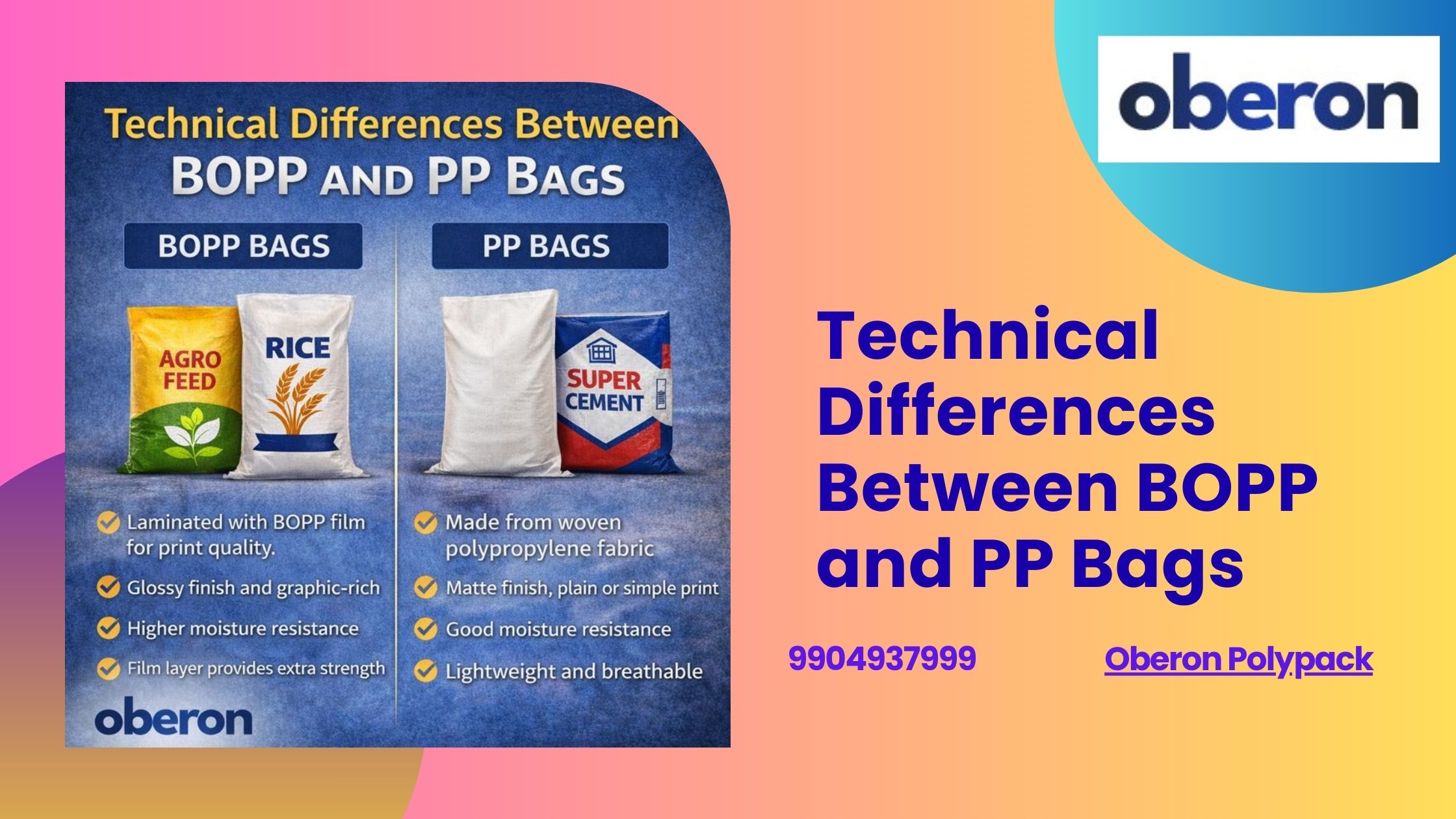
Woven plastic bags have become essential in the modern industrial and retail packaging as they are strong, flexible, and cost effective. Among these, bopp laminated bags, bopp bags, and pp bags are widely used across agriculture, food grains, cement, fertilizers, and consumer goods. Although they seem the same to the eye, there are important technical differences between BOPP and PP-based packaging that determine performance, print quality, durability and end-use appropriateness.
This precise blog will discuss the constructions, material science, manufacturing, functionality, and specifications of BOPP and PP bags based on their application. Knowledge of these differences guides companies to select the appropriate packaging model to use depending on branding, logistics, and protection needs.
Understanding the Basics of BOPP and PP Materials
Polypropylene (PP) is a thermoplastic polymer that is very well applicable in packaging because it is lightweight, it is resistant to moisture and it has high tensile strength. The bags made of Pp are usually made out of tapestry polypropylene tapes and are created into a robust fabric-like design. These bags are particularly used in packaging in bulk.
The BOPP or Biaxially oriented polypropylene is a specialty film that is manufactured by stretching polypropylene both in the machine and transverse direction. This biaxial orientation improves the clarity, strength, stiffness, and print receptivity. When BOPP film is laminated onto woven PP fabric, the result is bopp laminated bags that combine structural strength with high-quality surface graphics.
Raw Material and Structural Composition
The major technical difference is on the way the bags are built.
PP bags are produced using all polypropylene tapes that are woven into cloth. This is a woven fabric with a great load bearing capacity and resistance to tears. Variants such as pp woven bags, polypropylene woven bags, and woven polypropylene bags are all based on this core construction.
In contrast, bopp bags consist of two layers:
- A strength cloth layer of polypropylene.
- A BOPP film layer laminated on the surface for aesthetics and protection
The process of lamination of standard bags made of woven fabric becomes a superior laminated bag to offer better surface smoothness and barrier characteristics. When the woven substrate is laminated with BOPP film, it is commonly referred to as a bopp laminated woven bag.
Manufacturing Process: BOPP vs PP Bags
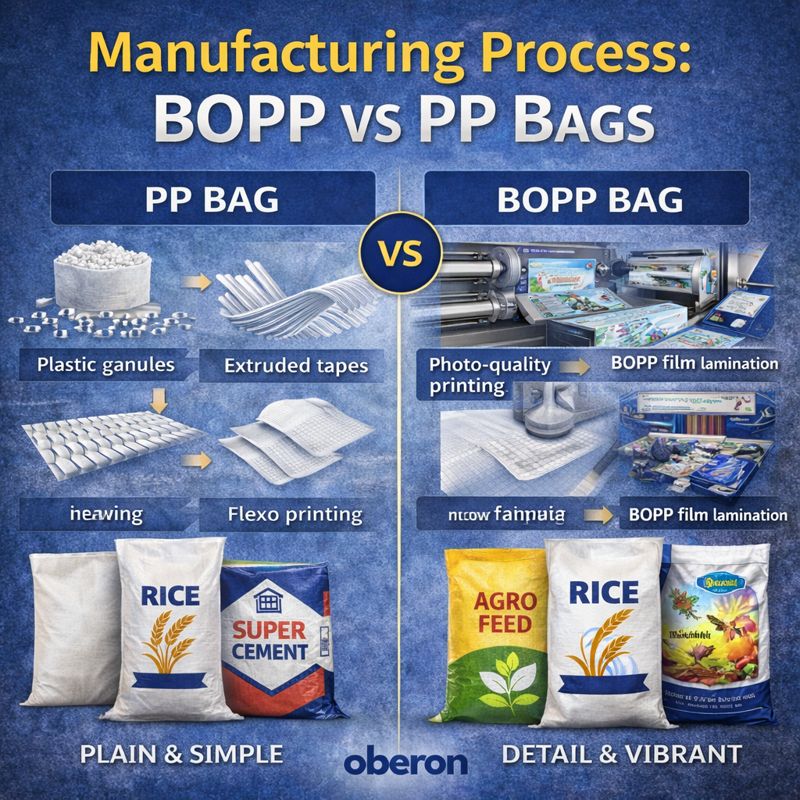
The manufacturing process is another key differentiator.
PP Bag Manufacturing
In the case of pp bags, the polypropylene granules are melted and extruded into fine tapes. These tapes are elongated, cut and woven. The cloth is then cut, fastened or heat-welded into bags. Should printing be needed it is typically flexographic printing onto the weaved surface and, therefore, does not provide much definitiveness to designs.
Products like pp woven sacks, pp woven fabric bags, and laminated pp woven bags follow similar base processes, with lamination added only when additional moisture protection is required.
BOPP Bag Manufacturing
In bopp laminated bags, the BOPP film is printed separately using rotogravure printing, which allows photo-quality images, sharp text, and vibrant colors. The woven polypropylene fabric is then adhesive or extrusion laminated with the print film. This multi-step process results in a visually superior and technically enhanced bag, ideal for retail-facing products such as bopp rice bag and branded bopp packaging bags.
Differences Between BOPP and PP Bags
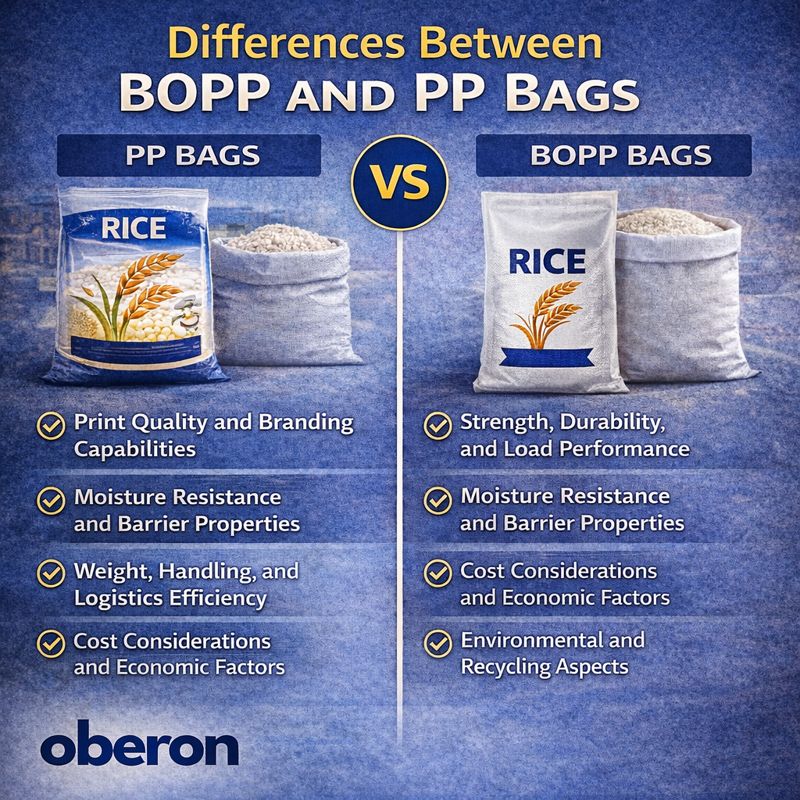
The comparison table below is easily understandable and can be optimized by search engines to be located right after the introduction of your blog entitled Differences Between BOPP and PP Bags.
This table will enable readers to grasp technical and functional differences very fast, as well as supply your main topic.
| Basis of Comparison | BOPP Bags | PP Bags |
|---|---|---|
| Full Form | Biaxially Oriented Polypropylene | Polypropylene |
| Common Types | BOPP laminated bags, BOPP plastic bags, BOPP woven bags | PP bags, PP woven bags, polypropylene woven bags |
| Structure | PP woven fabric laminated with printed BOPP film | Woven polypropylene fabric without BOPP film |
| Surface Finish | Smooth, glossy, premium finish | Rough, textured woven surface |
| Printing Quality | High-resolution rotogravure printing | Basic flexographic printing |
| Brand Visibility | Excellent for branding and retail appeal | Limited branding capabilities |
| Moisture Resistance | High due to laminated layer | Moderate; breathable unless laminated |
| Strength & Load Capacity | Strong with added surface protection | Very high strength for heavy loads |
| Durability | Resistant to abrasion and external damage | Extremely durable for bulk handling |
| Weight | Slightly heavier due to lamination | Lighter and more flexible |
| Cost | Higher due to lamination and premium printing | More cost-effective |
Print Quality and Branding Capabilities
Print quality is one of the conspicuous technical differences.
The textured woven surface of PP bags inhibits printing fines. Although it is possible to take the form of functional logos and minimal information, it is not easy to attain photographic clarity. The restriction is tolerable when it comes to industrial or commodity packaging but not so when retail branding is involved.
BOPP bags, on the other hand, offer exceptional print quality due to the smooth BOPP film layer. It is easy to produce high-resolution images, gradients, metallic effects, and designs in multi-color. This makes bopp plastic bags and bopp laminated bags the preferred choice for products that rely on shelf appeal and brand differentiation.
Strength, Durability, and Load Performance
These two types of bags are associated with strength, although their performances vary slightly.
PP bags are good in heavy-duty applications. The woven polypropylene structure distributes weight evenly, making pp woven sacks and polypropylene woven bags ideal for transporting bulk materials like cement, sand, grains, and fertilizers. They have great tear resistance and may be subjected to rough handling.
BOPP laminated bags retain the strength of woven PP while adding surface protection. The lamination enhances the resistance to abrasion and lowers fraying effect of the fibers. But under very rough environments, the laminated layer can scratch but it does not affect the integrity of the core of the bag.
Moisture Resistance and Barrier Properties
Packaging requires moisture protection particularly of food grains and chemicals.
The woven structure of the pp bags makes them breathable as they have little passage of air and moisture. This may help some agricultural commodities but be a threat to commodities that are sensitive to moisture.
BOPP laminated bags offer superior barrier properties. Its BOPP film coating is a moisture barrier envelope, which covers goods against humidity, dust, and external pollutants. This makes bopp woven bags and bopp rice bag solutions highly suitable for rice, flour, sugar, and animal feed packaging.
Weight, Handling, and Logistics Efficiency
In terms of logistics, the two types of bags are lightweight than the conventional packaging materials.
The lack of lamination is what makes PP bags a little lighter and therefore may help to save transportation expenses when making bulk shipments at large volumes. They are also easily stacked and compressed.
BOPP bags, while marginally heavier due to the laminated film, offer better shape retention and stack stability. This enhances palletization and presentation, especially retail as well as export packaging where pretty is as important as protection.
Cost Considerations and Economic Factors
Cost is often a deciding factor when choosing between bopp bags and pp bags.
The cost of manufacturing PP bags is cheaper because it is easier to make. They are used when there is low-margin high volume commodity and branding is not the priority.
BOPP laminated bags involve additional processes such as film production, high-quality printing, and lamination, resulting in higher costs. Nevertheless, this is worth investing in branded products in which packaging has a direct effect on the buyers and brand memory.
Environmental and Recycling Aspects
Both PP and BOPP bags are composed of polypropylene and hence they can be recycled using the same recycling streams. However, the laminated structure of bopp laminated bags can make recycling slightly more complex due to adhesive layers.
With that said, the current technology in packaging recyclability has increased, and most manufacturers have developed performance-sustainable laminated bags that are easy to recycle. PP woven fabric bags are often reused multiple times due to their durability, reducing overall environmental impact.
Application-Based Comparison
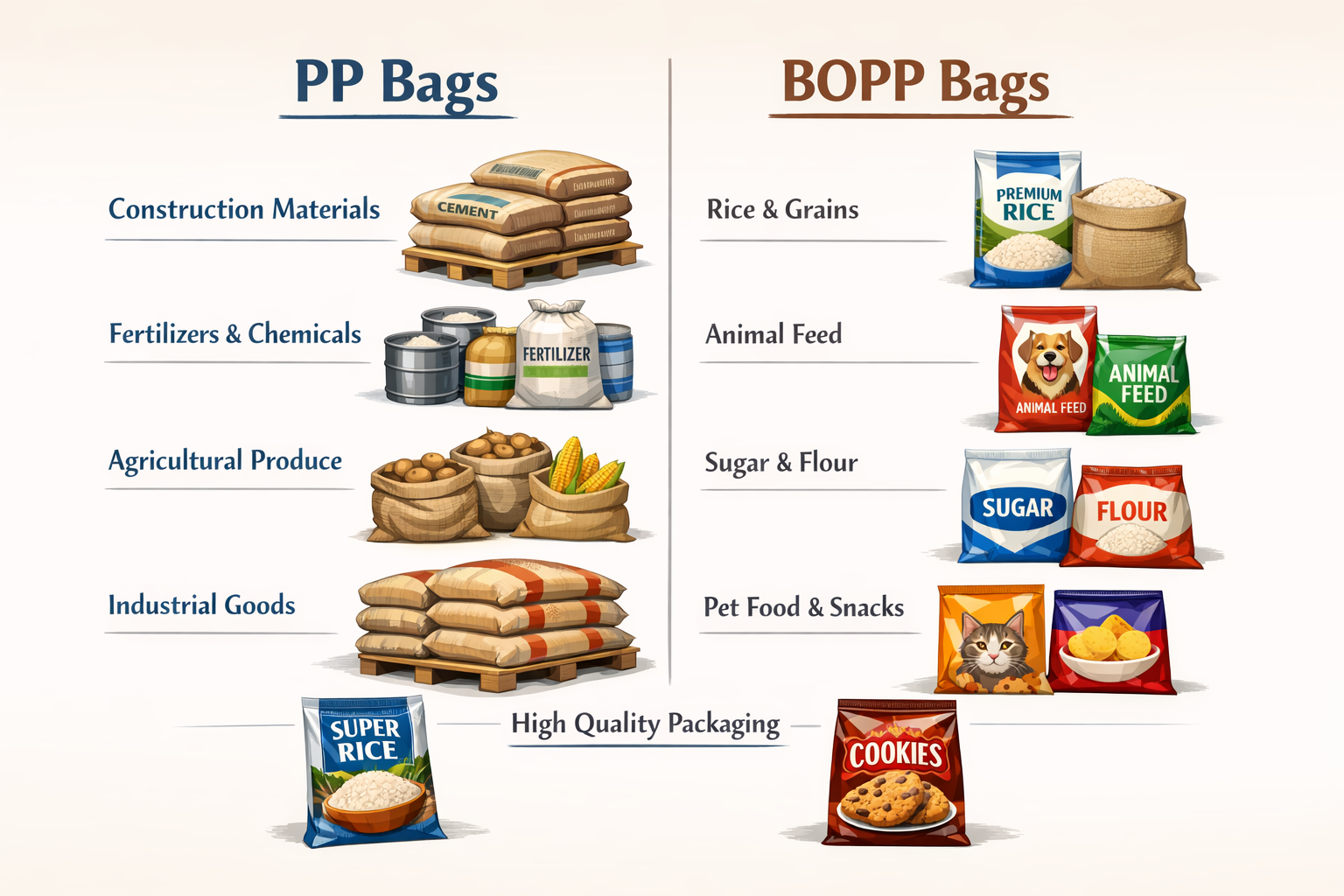
The technical distinctions are made more obvious once they are considered in the context of application.
PP bags are widely used for:
- Construction materials and concrete.
- Fertilizers and chemicals
- Agricultural produce
- Bulk industrial goods
Variants such as woven polypropylene bags, pp woven sacks, and pp woven fabric bags dominate these sectors.
BOPP bags are commonly chosen for:
- Packaging food grains and rice.
- Animal feed and pet food
- Sugar and flour
- Consumer products that have high presentation requirements.
Products like bopp packaging bags, bopp rice bag, and bopp plastic bags are designed to meet both functional and marketing needs.
Shelf Life and Product Protection
When it comes to shelf life, bopp laminated bags provide an advantage. The laminated sheet minimizes contact with moisture and contaminants, and extends the quality of the products. This mainly comes in export markets and transportation over long distances.
Although very strong, PP bags might need to have extra liners or inner lamination in order to obtain comparable levels of protection. Laminated pp woven bags are often used as a middle-ground solution when moderate barrier properties are sufficient.
Oberon Polypack: A Trusted Global Packaging Brand
Oberon Polypack stands as a leading manufacturer and exporter of premium packaging solutions, specializing in high-performance PP woven bags and BOPP laminated bags tailored for a wide range of industries. This brand has more than 25 years of experience in the industry, and it has produced durable export-style polypropylene (PP) packaging products, which suit the high-demand standards of the international standards and support heavy-duty tasks. At Oberon Polypack, quality and innovation have seen it become a business of preference to businesses in Africa, the Middle East, Asia, Europe, and the Americas.
The ethos of the brand is based on the synergies between strong manufacturing and low prices and tailored solutions. From standard PP woven bags to visually appealing and protective BOPP laminated bags, Oberon Polypack leverages advanced production technology and stringent quality checks to ensure every product delivers superior strength, moisture resistance, and print clarity. This reliability and performance is what has contributed to the development of Oberon Polypack as a reliable partner to global exporters and industrial customers who need high quality packaging solutions.
Conclusion: Choosing the Right Packaging Solution
Differences between BOPP and PP bags are much more than skin deep. PP bags are strong, economical and perfect in matters that require heavy packaging with strength and economy being of utmost importance. Their widespread use in pp woven bags, polypropylene woven bags, and pp woven sacks highlights their reliability in industrial and agricultural sectors.
On the other hand, bopp laminated bags and bopp bags combine the structural strength of woven polypropylene with the visual and protective advantages of BOPP film. They are the best bet when it comes to branded and retail-oriented packaging due to their high print quality, waterproof qualities, and high quality appearance.
Through learning about these technical differences, companies will be able to choose packaging that fits their product needs, brand strategy, and logistical needs both to provide protection and presentation of their products in the current competitive market.
FAQ Section
What are some of the products that Oberon Polypack produces?
Oberon Polypack makes high-quality PP woven bags, BOPP laminated bags, and various packaging fabrics for industrial and commercial applications.
Can your packaging products be customized?
Indeed, products may be tailored to customer needs in terms of size, GSM, lamination and print designs.
Do you offer export support?
Yes, the firm offers all export-related documentation and logistic coordination of international shipment.
What are the markets served by Oberon Polypack?
The brand provides packaging solutions to more than 60 countries across the world like Africa, Middle East, Southeast Asia and Europe.
Is it possible to make bulk orders?
There are bulk and container shipment orders, and large volume orders are charged competitively.
Does it have Oberon Polypack ISO certification?
The company has adopted the ISO-certified quality management systems in order to achieve consistency in manufacturing and reliability of the product.
Will you give product samples prior to bulk order?
Yes, the sample production and approval systems can be obtained before large scale production.